
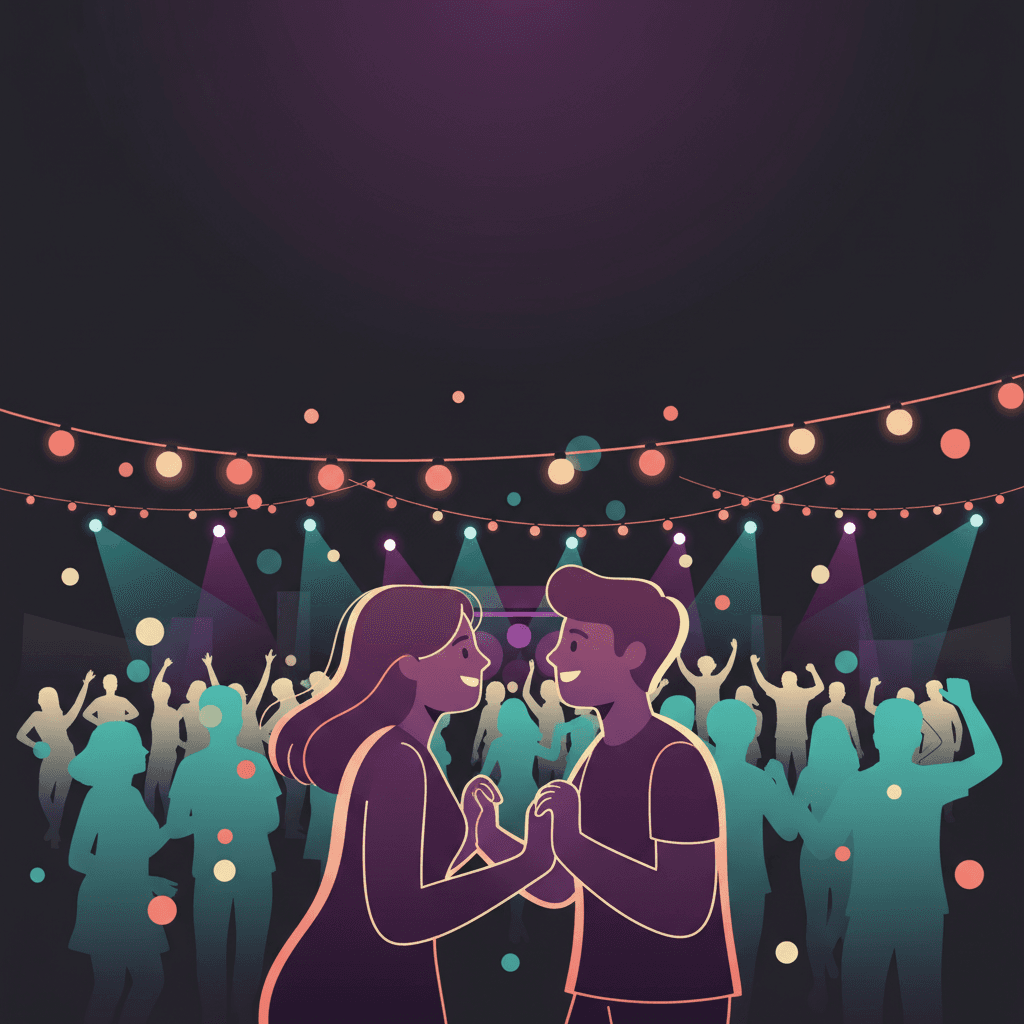
Stop Swiping at Festivals: How to Actually Meet People
Festival season is here and everyone is still on their phones. The practical guide to actually meeting people at Coachella, spring mixers, and outdoor events.
Spring festival season is here, and somehow — somehow — thousands of people are going to spend the next few months standing in the most electrically charged social environments on earth while refreshing their Hinge queue in the porta-potty line.
The irony is genuinely breathtaking.
You have spent $400+ on a wristband, burned a vacation day, and curated an outfit that went through four Pinterest boards and two Amazon returns. Your social strategy? Staring at a 6-inch screen hoping someone within 5 miles swipes right before the headliner goes on.
Here is the thing nobody wants to admit: festivals are objectively the best place to meet people. Real people. People who share your taste in music, your willingness to spend an irresponsible amount of money on a good time, and your ability to find joy in a crowd of strangers. The infrastructure for human connection is literally built into the experience — shared adrenaline, collective joy, a reason to talk to absolutely anyone.
You just have to put the phone down.
Why Festivals Are Actually the Perfect Dating Environment
There is a concept in psychology called "excitation transfer" — the idea that physiological arousal from one source (say, the bass from a massive sound system hitting your chest cavity) can intensify emotional responses to unrelated stimuli (say, the person next to you who is also losing their mind over the same song).
Translation: the experience itself does half the work for you.
Festivals collapse the usual social barriers. At a bar, walking up to a stranger can feel like an intrusion. At a festival, you are already in it together — the dust, the heat, the hour-long merch line, the fact that you both just watched someone crowd-surf and immediately lose their shoe. Shared experience creates instant social permission.
Add in the music filter: everyone at this event has already self-selected for similar taste. The dating app bio that says "I am into indie folk and underground electronic" means nothing without proof. Buying a ticket to this specific lineup is the proof.
This is why festival connections often feel different than app connections — they are built on actual, demonstrated shared values rather than optimized profile text. You already know this person spent money, took time off, and chose to be here. That is more signal than a curated photo grid will ever give you.
How to Actually Start a Conversation (Without Being Weird About It)
The most important thing about festival conversation-starting is to treat it like it is normal — because it is. People want to talk at festivals. The hard part is just getting out of your head enough to do it.
Use the environment as your opener
The event is literally handing you conversation starters every 30 seconds. Use them.
- "Did you catch that last set? I did not expect to lose my mind over it but here we are."
- "Do you know when the headliner goes on? I cannot figure out this schedule."
- "Is this your first time here? What stage are you heading to next?"
None of these are groundbreaking. They are not supposed to be. They are low-stakes openings that let the other person opt into a conversation without feeling ambushed. The goal is just to crack the door open. The conversation will find its own direction from there.
The compliment-plus-question formula
Complimenting someone at a festival is socially accepted currency. Everyone put thought into what they are wearing or what they are drinking or where they are standing. The trick is pairing the compliment with a question so it does not land like a dead end.
"Love your jacket — where did you find it?" opens a conversation. "Cool jacket" is just a comment floating into the air.
The question invites engagement. It signals that you are actually interested in the person, not just performing interest. That distinction comes through immediately.
Move before you talk yourself out of it
There is a reason dating coaches cite the three-second rule. It is not magic — it is just the observation that the longer you stand there deciding whether to approach someone, the more reasons your brain invents not to.
See someone interesting? Move toward them within three seconds of noticing. Not because hesitation makes you less attractive (though, arguably, it does), but because it eliminates the overthinking window entirely. The anxiety lives in the gap between noticing and acting. Close the gap.
Reading Festival Energy: Are They Into It?
Energy is everything at a festival, and reading it correctly is the difference between a great conversation and an awkward extraction.
Green lights:
- They make sustained eye contact — not the glazed "where is my friend" scan, but actual contact with something behind it
- Their body turns toward you during conversation
- They ask follow-up questions when you say something
- They laugh at actual content, not nervous "please wrap this up" laughter
- They casually mention future plans ("I am going to catch the third stage later...")
Yellow lights:
- Monosyllabic responses — not necessarily disinterest, but worth paying attention to. Are they distracted? Tired? Or is this just their vibe? Give it a beat and see if the energy shifts.
- The phone keeps coming out — could be a friend check-in, could be a signal
Red lights:
- Physical angle consistently pointing away from you
- Answering questions, then going quiet and looking elsewhere
- The visible search for a social exit ramp ("Oh, I think my friends are over there...")
The red lights are not rejections. They are redirects. Read them cleanly, make a graceful exit ("Nice to meet you — enjoy the rest of the set"), and move on. There are thousands of people here.
The Introvert Festival Playbook
Extroverts will tell you festivals are easy because everyone is already talking to each other. They are not wrong, but that framing does not help if the idea of walking up to strangers makes your stomach drop.
A few things that actually help when you are wired more quietly:
Find the edges. The most conversationally accessible spots at any festival are the peripheral ones — the food line, the water station, the merch tent, the spots just outside the main crowd. People here are waiting, less sensory-overloaded, and often genuinely open to a brief exchange. Start there before you try the packed floor.
Give yourself a mission. "I am going to talk to three new people today" is vague and exhausting. "I am going to ask someone a question about the lineup before the next set" is concrete and survivable. Small, specific goals beat open-ended social pressure every time.
Use groups as a softer entry point. Joining a conversation already in progress — with an obvious opener like "Sorry, I could not help but overhear — did you say you saw them live last year?" — is genuinely easier than cold-approaching one person. Groups have built-in social momentum that carries you.
Debrief after, not during. If you need to recharge between sets, do it. Step away, find a quiet corner, eat something, breathe. Introversion at a festival is not a liability — it just means you need to be intentional about managing your energy so you have some left when it matters.
From Festival to Follow-Through: How Not to Fumble It
Here is where most people crater. The conversation is good. The vibe is real. And then the set ends, the crowd shifts, and you get separated without exchanging anything concrete.
A few things that help:
Do not wait for a perfect moment. There is no perfect moment at a festival. The music is about to change, someone needs a drink, your friend is texting. If the connection is there and you want to stay in touch, say so before the next logistical interruption.
Be specific about the ask. "We should hang out" dissolves into the festival ether. "Are you going to be at the main stage for the closing set? Let us meet there at 9" gives you an actual plan with a built-in follow-through.
Phone number vs. Instagram — know your read. For most festival connections, Instagram is lower stakes and more likely to actually happen. A phone number carries implicit weight that can make the exchange awkward. Read the vibe and default to whichever feels lighter.
Follow up that night or the next day. Festival memories are vivid in the short term and fuzzy in the long term. A quick message while the experience is still fresh — "That closing set was ridiculous, hope you made it out okay" — is infinitely better than a cold "hey" four days later when neither of you remembers exactly what you talked about.
How Event-Focused Apps Change the Dynamic
Not all phone use at festivals is the enemy. Some of it is actually strategic.
Apps built around events rather than swiping change the equation entirely. Instead of cold-matching with strangers and then figuring out how to meet, you are connecting with people who are already going to be in the same place you are. The shared context already exists before you say a word.
Hooked works this way — join an event, see who else is attending, match within that shared context. The conversation does not start from zero. "We were both at that festival" is a better foundation than "we matched on an app and now we are pretending to be normal humans."
It bridges the gap between the digital warm-up and the in-person payoff, which is where most app connections fall apart anyway.
The Bigger Picture: Why Festival Season is a Moment
We are in a stretch where dating app fatigue is at a cultural high and in-person social events are roaring back. People are tired of the infinite scroll. They want to meet people in real life, in real time, with actual context — not a carefully engineered first impression across a screen.
Festival season is the most concentrated opportunity of the year to do exactly that. Multiple weekends of high-energy, self-selected gatherings of people who are, by definition, open to experience. The social infrastructure is already there. The energy is already there.
The only thing you have to supply is the willingness to look up.
This spring, try doing what you paid to be here for: being present, connecting with people in real time, and letting the experience do what it is designed to do. The apps will still be there Monday morning.
Some of the most interesting people you will ever meet are going to be at a festival this spring. They are going to be standing next to you, sweating in the same heat, losing their minds over the same song.
You just have to say something.
Related Articles
How to Meet Someone at a Wedding: A Single's Guide
Wedding season is prime time for singles. Learn how to meet someone at a wedding with practical, no-cringe tips for the cocktail hour, dance floor, and beyond.
Single at a Wedding? How to Actually Meet Someone
Being single at a summer wedding is a hidden dating goldmine. Learn how to meet someone, spark real connection, and turn a wedding moment into something more.
How to Meet Someone at a Wedding When You're Single
Flying solo to a wedding this season? Here's how to enjoy the night, meet people naturally, and maybe leave with more than cake — no awkwardness required.