
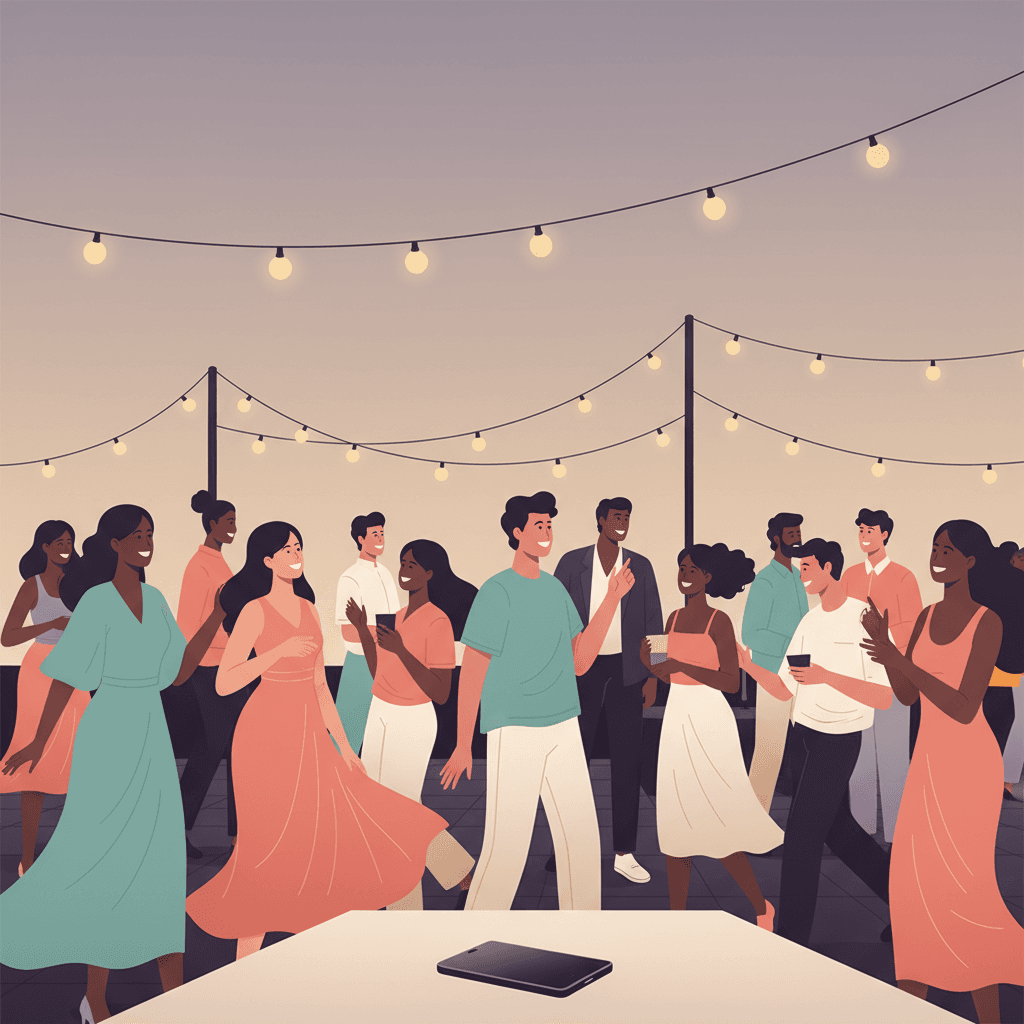
Why Event-Based Dating Is Replacing Dating Apps in 2026
Dating app burnout is real, and singles are noticing. Discover why more people are ditching endless swiping and finding genuine connections at live events this summer.
The summer you stopped swiping might be the summer you actually find someone worth knowing.
There's a specific kind of exhaustion that sets in around year three of using dating apps — not boredom, exactly, but a deeper weariness. You've optimized your photos, workshopped your bio, A/B tested your opening lines, and still come up empty in any way that actually matters. This isn't a personal failure. It's a structural one. The system wasn't designed to find you lasting connection. It was designed to keep you searching.
And if the collective shift happening right now in how singles approach dating is any indicator, a lot of people have figured that out.
The Great Swipe Fatigue of 2026
Dating app usage has been quietly plateauing while a parallel trend explodes in the other direction: real, in-person singles events. Mixers, speed dating nights, activity-based meetups, music festivals, beach parties — anywhere people show up as themselves, actually present, with no algorithm deciding who gets seen.
Event-based dating isn't new, obviously. People have been meeting at parties, concerts, and awkward office happy hours since forever. What's new is that it's being chosen intentionally — as a deliberate rejection of the swipe model, not just a supplement to it.
The symptoms of dating app fatigue are familiar to anyone who's experienced them: decision paralysis from infinite options, the hollow feeling of accumulating matches that go nowhere, the creeping sense that you're performing a version of yourself optimized for a thumbnail rather than living your actual life. When the match-to-meaningful-conversation ratio approaches zero, something breaks.
That something is the belief that the algorithm knows what you want better than you do.
What the Algorithm Gets Fundamentally Wrong
Dating apps are built on a filtering model: swipe through profiles until a set of stated preferences aligns. Age range, height, education level, a photo that hits the right aesthetic notes. The premise is that compatibility is a collection of searchable attributes — that you can predict chemistry from a 150-character bio and three carefully selected photos.
You already know this premise is wrong. You've felt it the moment a technically-perfect profile generated zero actual spark in person — and the moment someone you never would have swiped right on had you completely transfixed within sixty seconds of meeting them.
Attraction, chemistry, and real compatibility are deeply contextual. They emerge from timing, body language, shared laughter, the way someone holds themselves in a room. These aren't things you can photograph or describe in a profile. They only exist in person.
Event-based dating starts exactly where dating apps end — at the point of actual human presence.
This is the core mismatch: apps filter for what people say they want, while real life reveals what people actually respond to. Those two things are not the same. The science of attraction has known this for decades. The dating app industry chose to build a business on the pretense that they are.
Why This Summer Feels Different
There's a reason summer has always been peak "meet someone" season. More time outside. More social events on the calendar. Lower social inhibitions when the weather is warm and everyone's in a lighter mood. Summer compresses the distance between strangers.
This summer specifically, the energy feels like a genuine inflection point. The post-pandemic reshuffling of social habits has normalized showing up solo to events. Wedding season means meeting new people at receptions you'd normally spend exclusively at your table. Festival season means thousands of strangers sharing the same transcendent moment in a crowd. Outdoor concerts, neighborhood block parties, beach volleyball leagues, rooftop happy hours — the infrastructure for casual human connection is everywhere right now.
The singles who've burned out on swiping aren't waiting for a better app. They're actively seeking out structured in-person experiences because they've stopped believing a better algorithm is coming. This isn't a desperate fallback. It's a deliberate recalibration toward what actually works.
The In-Person Advantage (It's Not Just Vibes)
There's real psychology behind why meeting someone in person fundamentally changes the dynamic.
Context creates meaning. When you meet someone at a live event, you immediately have shared context — you've both been in the same room, reacted to the same band, navigated the same crowd. That shared experience becomes the natural foundation of conversation. "How are you enjoying this?" opens a door. "Hey, I swiped right on you" does not.
Body language and presence speak louder than photos. Research on attraction consistently shows that physical presence — voice tone, posture, eye contact, micro-expressions, energy — accounts for an enormous portion of initial appeal. None of this translates through a profile photo. The in-person version of someone almost always overrides your pre-formed impression, usually for the better.
Lower stakes, higher authenticity. There's a performance pressure embedded in dating app culture that most people don't consciously register until they escape it. Your profile exists to be evaluated. At an event, you exist to be present. The social context gives you something to be about other than being judged for dating potential. This usually makes people both more relaxed and more genuinely themselves — which, as it turns out, is more attractive.
Shared context builds instant social proof. Meeting someone at a curated event — a singles mixer, a book club social, a charity run, a rooftop trivia night — means you immediately share at least one meaningful data point: you both wanted to be in this specific place, doing this specific thing. That's a signal. It says something real about who someone is that no profile bio can replicate.
Where to Actually Find Your People This Summer
The question isn't whether in-person events work better for meeting people — that part's fairly settled. The question is which events are worth your time.
Music Festivals and Outdoor Concerts
Festival culture is uniquely good for meeting strangers. The setting is inherently communal — you're sharing an experience with thousands of people, and the barriers to conversation are dramatically lower than almost any other social setting. A shared reaction to a set, a spontaneous dance circle, a three-person conversation that forms naturally in a crowd — these are the moments that become stories.
If you're going to festivals this summer, go with an open agenda. Have your must-see performances, but build in significant unstructured time to wander, be present, and see who you meet. Some of the best connections happen in the spaces between the scheduled things.
Singles Mixers and Curated Events
The obvious choice, but worth distinguishing the good ones from the awkward ones. The best singles events are built around an activity or context, not around the bare explicit goal of finding a date. A cocktail-making class, a rooftop trivia night, a gallery opening with a social component — these work because the event itself gives you something to engage with and talk about beyond the audition-room energy of "we are all here to be selected."
Pure "meet people" events with no other structure can feel like a cattle call. Activity-based events feel like living your life with the possibility of meeting someone woven in naturally.
Sports Leagues and Outdoor Fitness
Summer recreational leagues — beach volleyball, kickball, bocce, tennis ladders, ultimate frisbee — are chronically underrated as social infrastructure. You see the same people repeatedly over a season. You have something to build camaraderie around. Friendly competition creates natural chemistry that's hard to manufacture in a cocktail party setting. And post-game hangouts are almost always part of the deal.
If you haven't signed up for a recreational league, this is your summer to do it. The social return on investment is genuinely high.
Community Gatherings and Neighborhood Events
Block parties, farmers markets, outdoor movie screenings, neighborhood food festivals — these aren't the flashiest options, but they carry a structural advantage most one-off events lack: repetition. Community gatherings happen regularly, which means you build familiarity with the same people over time. That slow-burn familiarity, the kind that develops over several chance encounters before either of you makes a move, is often where the most durable connections actually begin.
How to Actually Show Up (Even When It Feels Scary)
Let's be honest about why people gravitate toward apps despite knowing they don't work particularly well: safety. You're in control. You initiate contact on your own terms. You filter before you ever have to face actual rejection. The stakes feel lower when everything is mediated by a screen.
Real events strip that buffer away. Which is exactly what makes them work better — and also exactly what makes some people hesitant.
A few things that genuinely help:
Go with one or two friends, then deliberately split up. Having friends at an event gives you a social anchor. But arriving as a tightly bonded group and spending the whole night in your circle defeats the purpose. Agree in advance to circulate independently, and check back in occasionally. The "excuse" of friends nearby actually makes solo conversations easier, not harder.
Have one easy opener ready, not a line. Not something rehearsed — just a low-stakes, context-specific thing you could actually say to a stranger. "Is this your first time at one of these?" or "What did you think of that last act?" The hard part is the initiation. The conversation carries itself after that.
Let go of the specific outcome. The events where you meet the most interesting people are almost always the ones where you showed up to genuinely have a good time, not to find a date. This sounds like a platitude, but it's mechanically true: relaxed, present people are more attractive and more open simultaneously. The "looking" energy is visible, and it usually works against you.
Stay past the moment you first want to leave. This one is underrated. The best conversations at any event happen in the second hour, not the first. The first hour is everyone getting comfortable and warming up. Leaving early because you "haven't met anyone" is leaving before the show actually starts.
The App in Your Pocket Has a New Job
Event-based dating doesn't mean discarding your phone. The smartest approach isn't apps versus real life — it's using them in sequence rather than competition.
The real question is which direction the app runs: are you using it to replace in-person connection, or to amplify it? There's a meaningful difference. Apps built to connect people who are already at the same event — like Hooked — work with the in-person dynamic rather than against it. The shared context exists. The live experience is already happening. The app just makes the discovery layer easier in a room full of people you might not otherwise approach.
That's a fundamentally different proposition than swiping through strangers at 11pm. The technology should serve the moment, not simulate it.
This Summer, Something Different
The case for event-based dating isn't that apps are evil or that you need to suffer through awkward mixers. It's simpler: chemistry happens in person, and you can't optimize your way to it.
The algorithm doesn't know that you're funnier in real life than you sound in a bio. It doesn't know that your energy completely shifts in a place you genuinely love. It doesn't know what you look like when you're actually present and having a good time.
This summer, there are events near you — concerts, mixers, festivals, neighborhood gatherings — full of people who are tired of the same things you're tired of. The only thing standing between you and a genuinely good story is showing up to one of them.
Put the phone face-down. Go somewhere. See who you meet.
Related Articles
How to Meet Someone at a Wedding: A Single's Guide
Wedding season is prime time for singles. Learn how to meet someone at a wedding with practical, no-cringe tips for the cocktail hour, dance floor, and beyond.
Single at a Wedding? How to Actually Meet Someone
Being single at a summer wedding is a hidden dating goldmine. Learn how to meet someone, spark real connection, and turn a wedding moment into something more.
How to Meet Someone at a Wedding When You're Single
Flying solo to a wedding this season? Here's how to enjoy the night, meet people naturally, and maybe leave with more than cake — no awkwardness required.