
Why Real-Life Events Are Replacing Dating Apps in 2026
Dating app burnout is hitting a peak. Discover why more singles are ditching the swipe and finding real connection at live local events this summer.
Dating app burnout is at an all-time high. After years of swiping, ghosting, and algorithmic disappointment, a growing wave of singles is doing something radical: putting their phones down and walking into a room full of real people.
This isn't nostalgia. It's a movement.
The Algorithm Promised Connection—and Delivered Exhaustion
When dating apps launched, the pitch was irresistible: access to thousands of potential matches, filtered to your exact preferences, from the comfort of your couch. And for a while, it worked. Or at least, it felt like it might.
But somewhere between the hundredth unmatch and the fourteenth "hey" that went nowhere, something shifted. The apps that were supposed to solve loneliness started feeling like the source of it.
Here's what's actually happening: dating app algorithms are optimized for engagement, not connection. More time spent on the app means more ad revenue. The incentive isn't to help you find your person—it's to keep you searching. And once you see it, you can't unsee it.
The result? A generation of singles who feel more connected to their phones and lonelier than ever. The swipe model has become a full-time job with no benefits.
Why Group Events Are Winning in 2026
The shift toward event-based dating isn't accidental. It's a direct response to what apps fundamentally can't offer: context.
When you meet someone at a cooking class, a sunset rooftop mixer, or a summer beach gathering, you're not just seeing a curated selection of their best photos. You're watching how they interact with strangers. You're hearing their actual laugh. You're discovering whether they're the kind of person who offers to refill someone else's drink or hovers in the corner scrolling their phone.
That context does more work in ten minutes than a week of texting can do.
The Science Behind "Meeting in Person First"
Research consistently shows that face-to-face interaction accelerates trust and attraction in ways digital communication simply can't replicate. Proximity, body language, shared laughter, even the slight nervousness of being in the same room—these are ancient human signals that our brains are wired to read.
Dating apps strip all of that away and replace it with a thumbnail and a bio. And then we wonder why conversations feel flat and first dates feel like job interviews.
Group events restore the social ecosystem that makes natural attraction possible. You're not performing for an algorithm—you're just being yourself in a room with other people who showed up for the same reason you did.
The Fear That's Keeping You on the Apps
Here's the thing nobody talks about: dating apps are comfortable precisely because they keep the stakes low.
You can swipe from your bed. You can craft the perfect opener with time to think. If someone doesn't respond, you never have to see their face. Rejection is abstract, distant—easy to absorb into the endless scroll.
Real life feels scarier. Walking into a room full of strangers, not knowing if anyone will want to talk to you, feeling the full weight of being seen—that's genuinely vulnerable. And most people would rather risk chronic swiping fatigue than risk that kind of exposure.
But here's the reframe: that nervousness you feel before showing up? It's not a warning signal. It's aliveness.
The apps have trained us to mistake comfort for safety. But there's a difference between avoiding discomfort and avoiding growth. Every person who's made a real, lasting connection at a live event will tell you the same thing: it was worth the walk through the door.
How Group Events Actually Reduce Dating Anxiety
Counterintuitively, group events are lower stakes than one-on-one first dates.
When you go on a traditional date, the pressure is enormous. You're the entire entertainment. Every silence is awkward. The evaluation is mutual and explicit. It's a performance.
At a group event, the dynamic shifts completely:
- You have natural conversation starters — the event itself is a shared experience you can discuss
- There's no pressure to "perform" — you're participating in something fun alongside other people
- You can move on gracefully — if a conversation isn't clicking, the event gives you an easy out
- Attraction develops organically — you notice people you might never have swiped right on
This is why summer is such a powerful time to lean into events. The season already creates a permission structure for spontaneity. Outdoor gatherings, rooftop parties, beach meetups—they carry a lightness that strips away the formality that makes dating feel like a chore.
What This Summer Looks Like for Real-Life Daters
We're at a turning point. The early summer calendar is packed with exactly the kinds of events that create genuine connection:
Outdoor concerts and festivals — shared music experiences are one of the fastest paths to a sense of "we." You're both inside something larger than yourselves, which creates instant common ground.
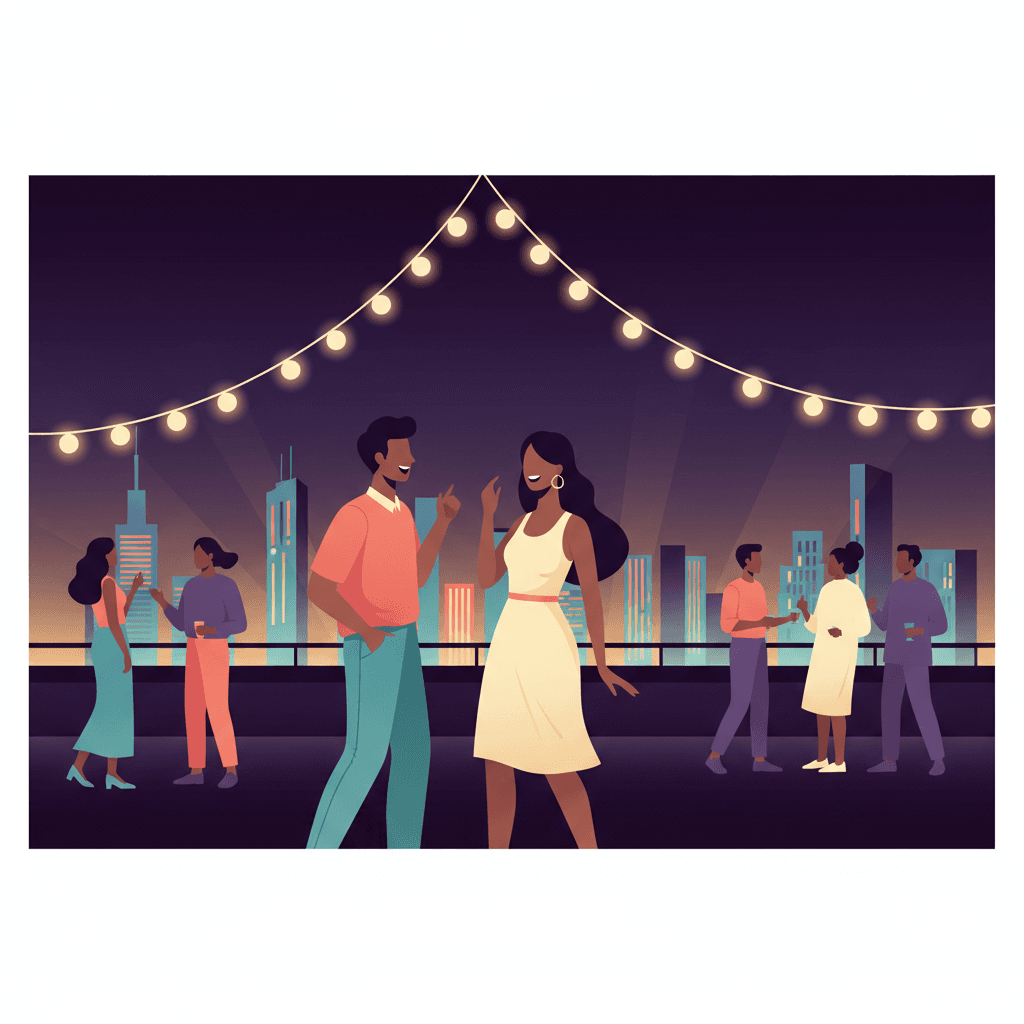
Rooftop and pool parties — the combination of warm weather, casual dress, and open space removes the social formality that makes first conversations stilted. People are simply more relaxed when the sun is setting and the drinks are cold.
Graduation and milestone gatherings — these events bring together people in transition, which creates natural depth of conversation. People are reflecting, hopeful, and genuinely open to new connections.
Neighborhood and community events — farmers markets, outdoor movie nights, neighborhood block parties. Low-pressure, recurring, and built around shared place rather than shared swipe history.
Singles mixers with a purpose — when an event is organized around an activity (trivia, cooking, art), the focus shifts from "find a date" to "do the thing," which paradoxically makes connection far easier.
The Female Agency Revolution in Event Dating
One of the most interesting trends reshaping the event dating scene is who's showing up to organize it.
For years, the dating world defaulted to a model where men initiated and women waited to be chosen. Apps encoded this dynamic into their mechanics—the result was women exhausted by unsolicited messages and men frustrated by low match rates. Everyone loses.
Event-based dating is naturally flipping this script. When a woman hosts or curates a social experience—a book club mixer, a hiking group, a dinner party with a rotating guest list—she's setting the context, choosing who's in the room, and controlling the energy of the space. That's a fundamentally different power dynamic than waiting for a notification.
The women doing this aren't waiting to be discovered. They're building the environment where discovery happens on their terms.
And men who show up to events hosted and curated by women enter a space where her comfort and agency are already built in—a much better starting point for genuine connection than a cold message in an inbox.
Making the Shift: A Practical Framework
Knowing that events are better in theory is one thing. Actually walking through the door is another. Here's how to make the shift without it feeling overwhelming:
Start small. You don't need to go to a singles mixer your first night out. Go to a neighborhood event, a meetup around an interest you already have, or a fitness class. The goal is simply to be in proximity to people.
Go with a loose goal. Not "find a date"—that's too much pressure. Try "have one interesting conversation" or "learn one new person's name." Small wins build the habit.
Show up consistently. You're not going to meet the right person on your first outing. But you might meet someone who introduces you to someone else, or find a recurring event you love, or simply rebuild your social confidence. Consistency matters more than any single event.
Use apps to find, not replace, events. Apps can actually be useful for discovering what's happening in your city. Let them serve that function—as an event discovery tool—rather than as a substitute for showing up in person.
Check in honestly afterward. After an event, notice how you actually feel compared to a night of swiping. Most people are surprised by the difference, even after an event where nothing romantically "happened."
The Bigger Picture
Strip away the apps and the algorithms and the optimization, and what everyone's really looking for is pretty simple: to feel seen by someone who actually showed up.
Not a perfect profile. Not an algorithm-curated compatibility score. Just the experience of being in a room with someone, of both choosing to be present, of something clicking—or not—in real time.
That's what events offer. And that's why, in 2026, the most interesting conversation in dating culture isn't about which app is winning. It's about why more and more people are deleting them.
If you're ready to try a different approach, Hooked is built specifically around this idea—connecting people who are already sharing a real-life event, rather than matching strangers and hoping for the best. With 73+ events and over 4,300 participants, the evidence is clear: the best connections start when you're already in the room.
This summer, the best date you'll go on probably won't start with a right swipe. It'll start with showing up.
Related Articles
How to Meet Someone at a Wedding: A Single's Guide
Wedding season is prime time for singles. Learn how to meet someone at a wedding with practical, no-cringe tips for the cocktail hour, dance floor, and beyond.
Single at a Wedding? How to Actually Meet Someone
Being single at a summer wedding is a hidden dating goldmine. Learn how to meet someone, spark real connection, and turn a wedding moment into something more.
How to Meet Someone at a Wedding When You're Single
Flying solo to a wedding this season? Here's how to enjoy the night, meet people naturally, and maybe leave with more than cake — no awkwardness required.