
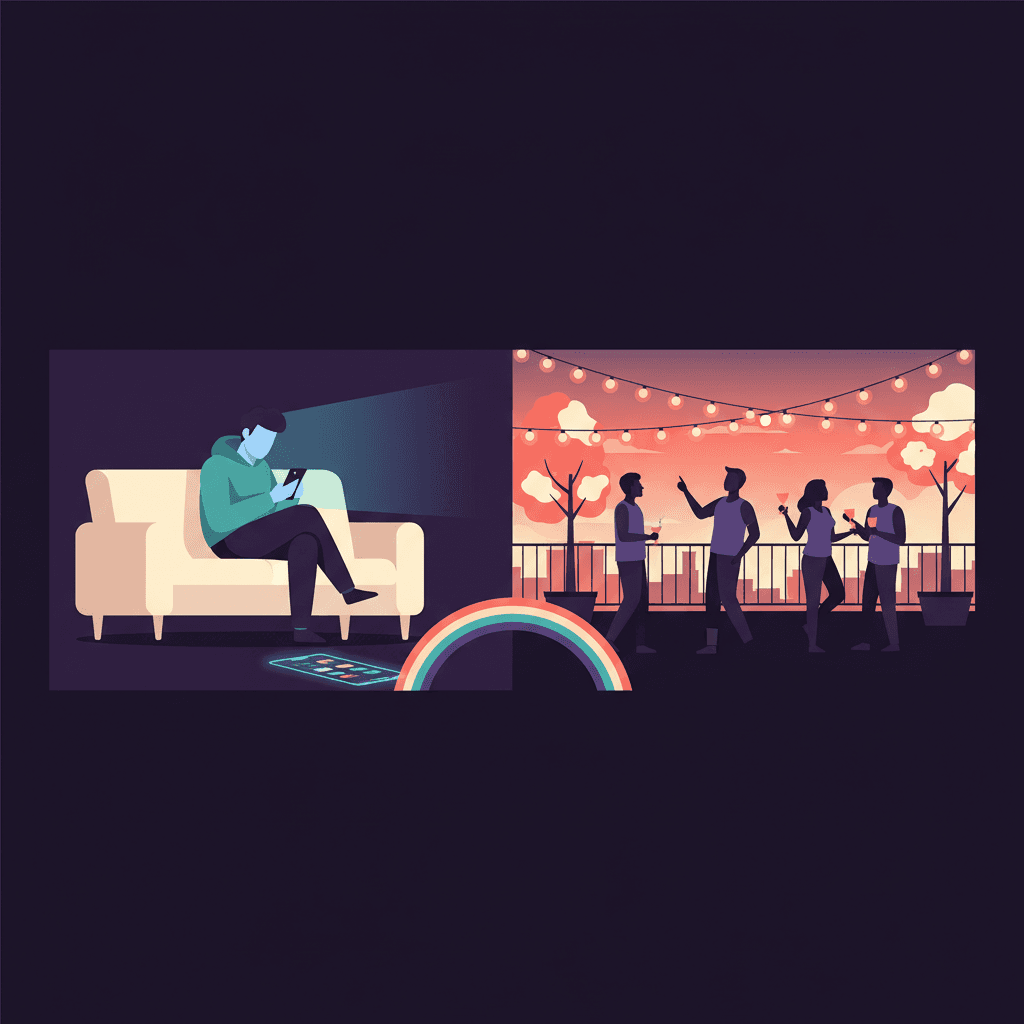
Still Lonely Despite Dating Apps? Here's What's Missing
Dating apps promise connection but often leave you lonelier. Learn why real-world events solve the belonging gap apps can't — especially this spring.
There's a strange paradox sitting at the center of modern dating culture: we've never had more tools to connect with people, and yet loneliness is climbing year after year. A Surgeon General's advisory literally declared it a public health crisis. Dating apps were supposed to be the solution. Instead, for millions of people, they've quietly become part of the problem.
If you've ever closed a dating app feeling somehow emptier than before you opened it, you're not imagining things. That hollow feeling is real, it's common, and understanding it might be the most useful thing you do for your love life this spring.
The Loneliness Paradox: More Connection Tools, More Isolation
Modern dating apps are remarkable pieces of technology. They aggregate thousands of potential matches, learn your preferences, and surface people you'd never cross paths with in real life. Logistically, they're impressive.
But here's what they were never designed to do: make you feel like you belong.
There's a fundamental difference between being matched with someone and feeling genuinely connected to them. Apps excel at the former. They were built to solve a coordination problem — getting two people who might like each other into the same digital space. What happens after that, the awkward openers, the text-based getting-to-know-you, the slow building of trust with a stranger, that's entirely on you, with no scaffolding from the app at all.
The result is an exhausting loop. You optimize your profile. You craft the perfect opening line. You survive the anxiety of waiting for a response. You text for two weeks, build something that feels almost real, and then watch it fizzle when one of you stops replying. Then you start over. The app stays open. You stay in the cycle.
Research consistently shows that the quality of connections matters far more to wellbeing than the quantity — and that digitally mediated relationships, especially with strangers, tend to deliver lower quality. You can be surrounded by options and still feel profoundly alone.
How the Business Model Works Against You
To understand why apps often leave you lonely despite their promises, it helps to understand how they make money.
Dating apps profit from engagement, not outcomes. An app that successfully pairs you with your person loses a customer. An app that keeps you swiping, hoping, and re-subscribing to premium features is maximizing its business model. This isn't a conspiracy — it's just economics. But it means the incentives are structurally misaligned with your actual goal.
This is why you'll notice that premium features tend to promise incremental improvements to your reach or visibility rather than fundamentally solving why connection feels hard. More likes. More Super Swipes. More profile boosts. None of these address the real friction: that building genuine trust with a stranger through a screen is inherently difficult, and no algorithm can shortcut the human messiness of it.
When users question whether premium subscriptions are worth it, they're often right to be skeptical. The product is optimized for the platform, not for you.
The "I'll Put Myself Out There Once I'm Ready" Trap
One of the most common responses to dating fatigue is retreating into a self-improvement phase. You decide you need to get in better shape first. Or work on your confidence. Or finally deal with that anxiety. Or just... figure yourself out before you're "ready" to date again.
This impulse comes from a real and understandable place — wanting to show up as your best self. But here's the uncomfortable truth: waiting until you feel ready is one of the most effective ways to never start.
Social confidence isn't something you build in isolation. You don't develop it by reading enough books, meditating enough mornings, or hitting enough gym sessions. You build it by being in social situations — even awkward ones, especially awkward ones — and discovering that you can handle them. That you can walk into a room full of strangers, make one or two good conversations, and leave feeling a little more like yourself.
The self-improvement mode people enter to prepare for social connection often delays the very thing that would actually build their confidence: showing up, in real life, around other people. The gym makes you fitter. The events make you socially confident. You need the events.
You don't need to be a finished product to be worth meeting. Nobody is.
What Real Connection Actually Requires
Think about the most meaningful connection you've made with another person. How did it happen?
Odds are, it involved some combination of: shared context (you were both somewhere, doing something), repeated exposure (you kept running into each other or chose to spend more time together), and authentic interaction (you were being genuinely yourself rather than a curated version of yourself).
Dating apps, by design, strip away most of these ingredients. You're matching with a photograph and a paragraph. There's no shared context — you're just two strangers staring at a screen. The interaction is delayed and text-mediated, which makes authenticity harder. And because you can match with dozens of people simultaneously, the urgency to genuinely invest in any one connection is low.
Real-world events restore all three elements. When you meet someone at a rooftop mixer in April, you immediately share context. You're both the kind of person who showed up to this thing, on this night, in this city. You have something to talk about that isn't "so what do you do?" You can read body language, sense energy, notice whether someone's laugh is real. These are the raw materials of actual human connection, and they're completely unavailable on an app.
Spring Is Nature's Permission Slip
There's a reason spring has always been associated with new beginnings, and it's not just poetic. After months of cold weather that naturally contracts social lives — fewer excuses to go out, more nights on the couch with Netflix — spring genuinely reopens the world.
Rooftop bars come back to life. Outdoor markets and festivals fill up. Parks become social gathering points. Festival season kicks off. The energy of the city shifts palpably, and with it, people's openness to new experiences and new people.
If you've been in a dormant period — socially, romantically, or both — spring is a genuine inflection point. Not because anything magical happens on a specific date, but because the external conditions for meeting people in real life improve dramatically, and there's a collective social mood that makes everyone slightly more open, more likely to make eye contact, more willing to start a conversation with someone they've just met.
Coachella. Watch parties. Outdoor dining. Rooftop happy hours. Spring art openings. These aren't just leisure activities — they're the infrastructure of real-world connection. Use them.
How to Use Events to Build Social Confidence (Starting This Weekend)
You don't have to be an extrovert to get value out of social events. A few principles that actually work:
Lower the stakes deliberately. Go with the goal of having one interesting conversation, not finding your next relationship. One conversation. That's it. Everything else is a bonus. This reframe alone can dissolve most of the anxiety.
Arrive slightly early. It sounds counterintuitive, but it's easier to enter a room that has 10 people than one that has 60. You can settle in, get a drink, find your footing before it fills up.
Use the venue as a conversation starter. "Is this your first time at one of these?" or "Did you try the [food/drink/activity]?" are genuinely easy openers when you're sharing physical space. You're not generating conversation out of thin air — the event gives you something to reference.
Let go of the outcome. Most conversations at events won't lead anywhere romantic, and that's fine. They still count. They still build the social muscles that make you better at this. Every conversation where you don't die is practice.
Bring a friend the first time. Not as a social crutch, but as a low-pressure wingperson. Having someone to debrief with on the way home makes the whole thing feel lighter and more fun.
Go to things you're genuinely interested in. Wine tastings, trivia nights, art openings, cooking classes, sports watch parties — events built around something you actually care about put you in a room with people who share that interest. The conversation practically writes itself.
The Trust Advantage Nobody Talks About
Here's something that rarely gets discussed in the dating conversation: real-world events solve the authenticity and trust problem that apps fundamentally cannot.
When you match with someone online, you're dealing with the curated version of who they've decided to present. Profile photos are cherry-picked. Bios are drafted and redrafted. In the early texting phase, everyone is somewhat performing. This isn't dishonesty so much as the natural result of a medium that gives you unlimited time to craft your responses — and no one to hold you accountable.
In person, at an event, that performance is much harder to sustain. You can see whether someone is warm or cold in their interactions with the people around them. You can hear whether their laugh is real. You get a sense of their actual energy — nervous, confident, genuine, performative. These signals are rich and fast and almost impossible to fake.
And critically: if you meet someone at a specific event, there's a thread of verifiable shared reality. They were there. You were there. Mutual connections build naturally — maybe you both know the organizer, or you both ran into the same group earlier in the evening. This social fabric creates accountability and authenticity that purely app-based connections simply don't have. It's harder to be someone you're not when the context of your meeting is traceable and shared.
This is exactly the insight behind apps like Hooked, which connects event attendees within the context of real events, so the matching feels grounded in shared experience rather than served by an algorithm with no context.
Your Next Step (It's Not to Optimize Your Profile)
If you're feeling the particular exhaustion of dating app fatigue — the loneliness that somehow persists despite technically having options — the answer probably isn't to upgrade to a premium plan or take better photos.
The answer is to change the medium.
Get out this spring. Find events that match your vibe — they exist in every city, nearly every weekend, across every interest. Lower the stakes. Show up with curiosity rather than pressure. Trust that social confidence is built by being social, not by preparing to be social.
You're not broken. You're not behind. You don't need to fix yourself before you're ready to meet someone. You just need a better context for connection than a 5-inch screen at midnight.
The connections that last are forged in shared experience, not shared algorithms. And spring — with its rooftop bars and festival energy and renewed sense of possibility — is exactly the right time to remember that.
Related Articles
How to Meet Someone at a Wedding: A Single's Guide
Wedding season is prime time for singles. Learn how to meet someone at a wedding with practical, no-cringe tips for the cocktail hour, dance floor, and beyond.
Single at a Wedding? How to Actually Meet Someone
Being single at a summer wedding is a hidden dating goldmine. Learn how to meet someone, spark real connection, and turn a wedding moment into something more.
How to Meet Someone at a Wedding When You're Single
Flying solo to a wedding this season? Here's how to enjoy the night, meet people naturally, and maybe leave with more than cake — no awkwardness required.