
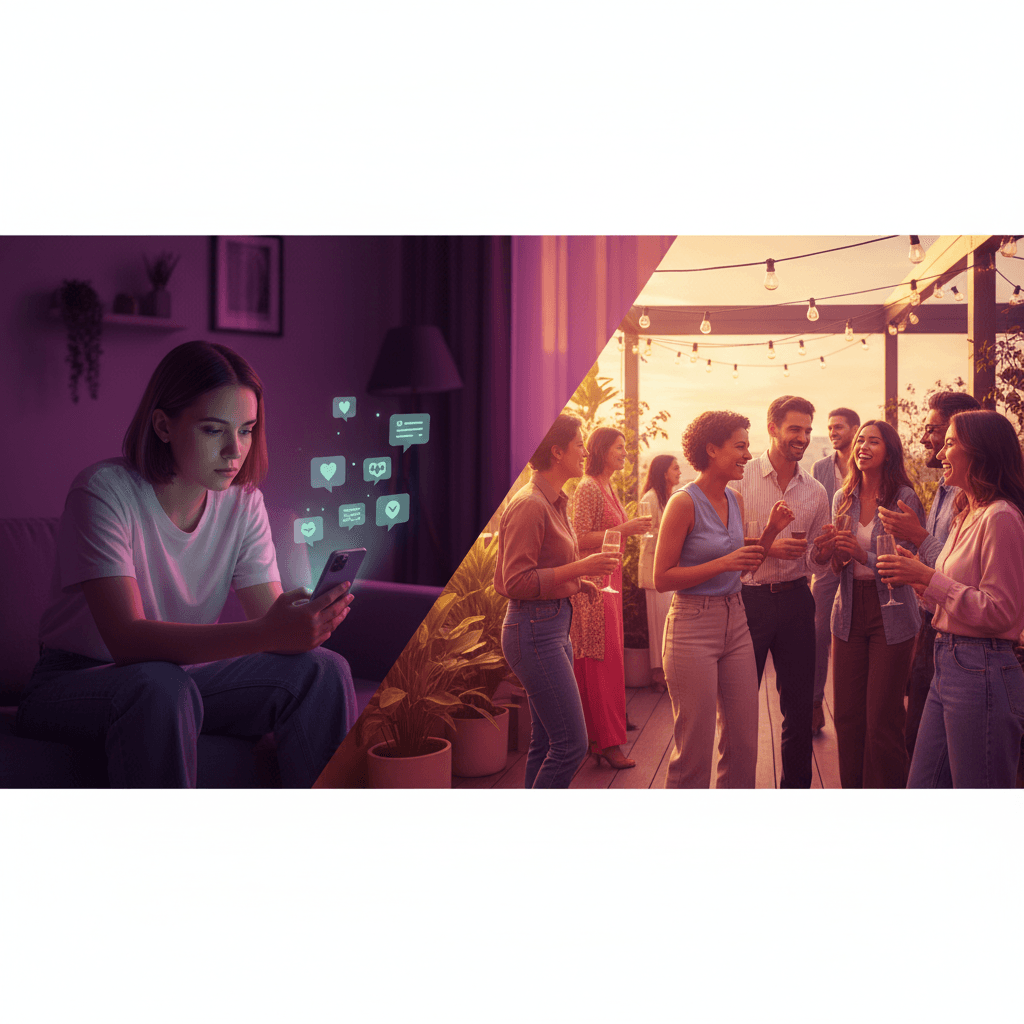
Dating App Fatigue Is Real — Here's What to Do About It
If swiping feels like a second job and every match leads nowhere, you're not alone. Here's why dating app burnout happens and what actually works instead.
You used to look forward to it. Notification pops up, someone liked your photo, maybe this one's different. You'd open the app with a little jolt of dopamine and start scrolling through faces like you were browsing Netflix — except the stakes were your love life.
Now? You open the app and immediately feel tired. You swipe left on someone who's probably perfectly nice because their bio mentioned hiking and you just cannot have another conversation about hiking. You match with someone, exchange three messages about what neighborhood they live in, and then one of you ghosts. You don't even feel bad about it anymore. That's the part that worries you.
Welcome to dating app fatigue. It's not a personality flaw. It's not you being too picky or not trying hard enough. It's what happens when a system designed to keep you engaged starts making you feel worse instead of better.
And right now, millions of people are going through exactly the same thing.
Why It Happens
Dating apps are engineered like slot machines. Variable rewards, infinite scroll, the little rush when someone matches with you. That design was incredibly effective at getting people to use the apps — and profoundly terrible at helping them actually find someone.
Here's the cycle: You swipe. You match. You text. You get excited. You meet. It's... fine. Or it's bad. Or they ghost. Either way, you're back on the app the next day, doing it again, hoping the next one will be different.
After enough rounds of that, your brain does what brains do — it starts protecting you from the disappointment. You become less invested, more cynical, quicker to dismiss. You swipe faster. You care less. You stop writing thoughtful first messages because why bother, right?
That's not you being jaded. That's learned helplessness. Psychologists have studied this for decades — when effort repeatedly fails to produce results, people stop trying. Dating apps have accidentally created a mass-scale experiment in learned helplessness, and the results are exactly what you'd expect.
The Signs You're Burned Out
You might not even realize it's happened. Burnout doesn't announce itself — it creeps in. Here's what it looks like:
- You swipe mindlessly. Left, left, left, left. You're not even reading bios. You're just... moving your thumb.
- Matches feel like obligations, not excitement. Someone liked you? Cool. You'll reply... eventually. Maybe.
- Every conversation feels the same. "What do you do? Where are you from? What are you looking for?" You could write a script for it at this point.
- You cancel dates you set up. You were excited when you made the plan. Now it's Thursday and you'd rather stay home.
- You deleted the app. Then redownloaded it. Then deleted it again. The cycle of quitting and relapsing is its own kind of exhaustion.
If three or more of those hit home, congratulations — you're not broken. You're just burned out on a system that wasn't designed with your wellbeing in mind.
What Actually Helps
Step 1: Delete the apps. For real this time.
Not for a "break." Not "I'll just check it once a day." Delete them. Remove them from your phone. If that feels scary, that's exactly why you need to do it. The fact that not being on a dating app feels like you're doing something wrong tells you everything about how normalized this particular hamster wheel has become.
You will not miss your soulmate because you took a month off Hinge. I promise.
Step 2: Go where the people are.
The irony of dating apps is that they were supposed to help us meet people — but they actually made us worse at it. We outsourced the entire process to an algorithm and forgot that we already know how to do this. We just need a room, some people, and a reason to talk.
So go find those rooms. Singles events, cooking classes, trivia nights, rooftop socials, art workshops, volunteer groups, sports leagues, pub crawls. Places where people gather with the explicit or implicit intention of meeting new humans.
The magic of these places isn't that everyone there is single (though at singles events, they are). It's that you get to experience someone as a person before deciding if you're attracted to them. You hear their laugh. You see how they treat the bartender. You watch them get weirdly competitive about trivia. That stuff matters infinitely more than a curated photo grid, and you can't get any of it through a screen.
Step 3: Lower the stakes.
Part of why dating apps are so exhausting is that every interaction is loaded with expectation. You're explicitly here to find a romantic partner. Every conversation is an audition. Every date is a test.
In real life, you can just... meet people. Not every interaction needs to be a "Is this the one?" moment. Sometimes you meet someone cool and you become friends. Sometimes you meet someone and there's a spark. Sometimes you meet someone and nothing happens and that's fine because you had a fun night anyway.
That shift — from "I need to find someone" to "I'm going to enjoy being around people" — is the antidote to dating fatigue. It takes the pressure off completely, and ironically, that's when the good stuff tends to happen.
Step 4: Let technology help, but differently.
Deleting dating apps doesn't mean going Amish. Technology can absolutely help you meet people — just not through infinite swiping.
Event discovery apps. Social platforms that connect you with people at real-world events. Tools that show you who else is at the same venue, let you express interest, and tell you when the feeling is mutual — so you skip the guessing game and go straight to the actual human interaction.
That's not swiping. That's using technology the way it should be used: as a bridge to real life, not a replacement for it.
Step 5: Be patient with yourself.
If you've been on dating apps for years, your brain needs time to recalibrate. You've been conditioned to evaluate people in two seconds based on a photo. You've been trained to expect instant gratification and to discard people at the first sign of imperfection. Undoing that takes time.
The first few events might feel weird. You might not meet anyone. You might feel rusty. That's okay. Real-world social skills are like muscles — they atrophy if you don't use them, but they come back fast once you start.
The Bigger Picture
Dating app fatigue isn't just a personal problem — it's a cultural one. An entire generation learned to date through screens, and now they're realizing that something fundamental was missing from the experience.
What was missing was presence. The feeling of being in a room with someone. Eye contact across a crowded space. The electricity of a conversation that's happening right now, not in a text thread that you'll get back to whenever you feel like it.
People are hungry for that. Genuinely hungry. Singles events are selling out. Social gatherings are growing. The pendulum is swinging back toward in-person connection, and it's not because people are anti-technology — it's because they finally understand what technology can and can't do.
It can give you access. It can show you who's out there. But it cannot give you the thing you're actually looking for, which is the feeling of being seen by another person. In a room. Face to face. For real.
If you're exhausted by apps, that's not a failure. It's your instincts telling you to try something different. Listen to them.
Related Articles
How to Meet Someone at a Wedding: A Single's Guide
Wedding season is prime time for singles. Learn how to meet someone at a wedding with practical, no-cringe tips for the cocktail hour, dance floor, and beyond.
Single at a Wedding? How to Actually Meet Someone
Being single at a summer wedding is a hidden dating goldmine. Learn how to meet someone, spark real connection, and turn a wedding moment into something more.
How to Meet Someone at a Wedding When You're Single
Flying solo to a wedding this season? Here's how to enjoy the night, meet people naturally, and maybe leave with more than cake — no awkwardness required.