
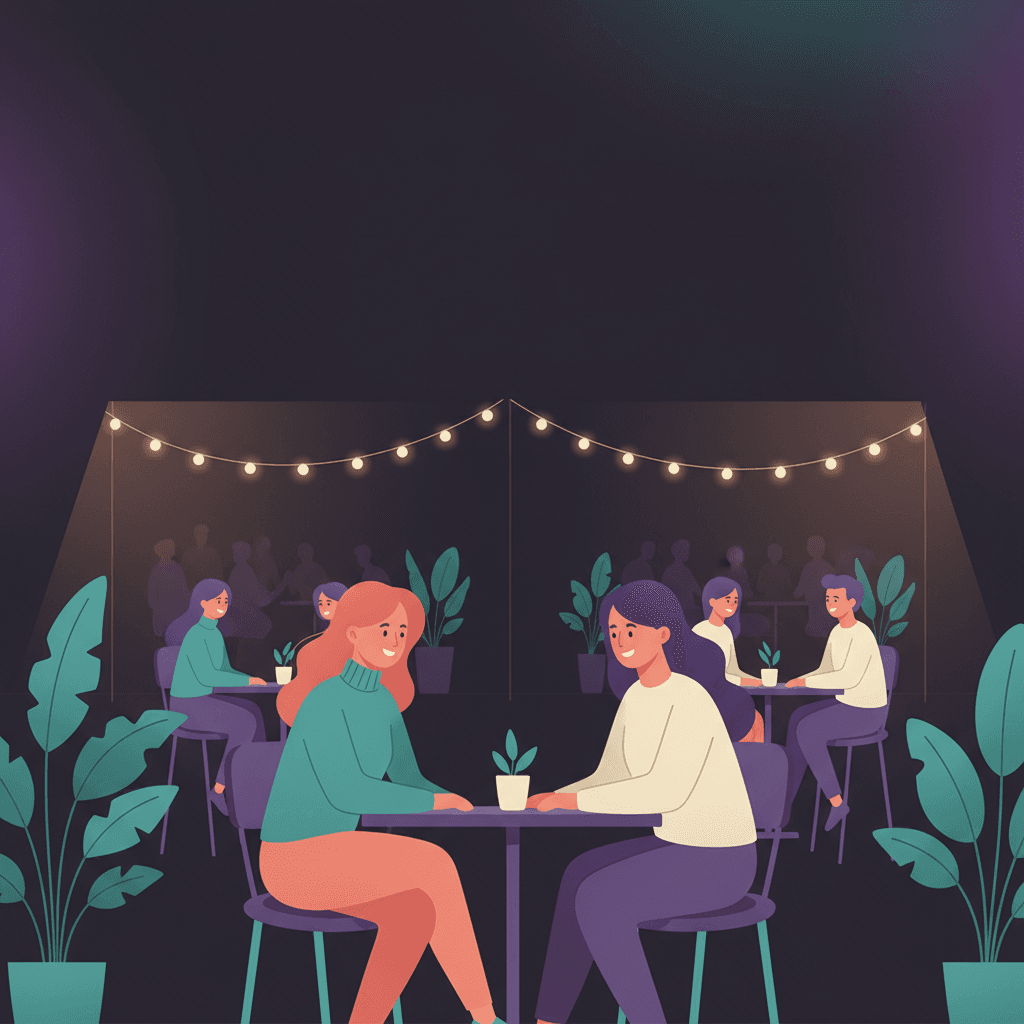
Why Dating Events Are Better Than Apps for Introverts
Swipe fatigue is real — especially for introverts. Here's why showing up to a real event beats optimizing your profile, and how to actually enjoy it.
If someone told you that the solution to your dating app burnout was to go to an event full of strangers, you'd probably laugh and then close this tab. That's a completely reasonable response. And yet — hear this out — real-world events might actually be the most introvert-friendly way to date that exists right now.
Yes, really. And no, this isn't a hot take designed to get you out of the house. The math actually checks out.
Why Dating Apps Are an Introvert's Worst Nightmare (Disguised as a Gift)
On paper, dating apps should be perfect for introverts. You can filter, curate, draft the ideal opener, and ghost anyone who sends "hey" without consequence. You control the pace. No crowds, no awkward silences you can't escape, no forced eye contact.
Except in practice, apps are exhausting in a very specific, introvert-unfriendly way.
Profile optimization is a performance. You're essentially running a personal marketing campaign — writing a personal brand statement, curating your five most flattering photos, workshopping a bio that says "I'm fun but not trying too hard." For introverts who tend toward authenticity over performance, this is draining before the first conversation even starts.
The small talk never ends, and it never goes anywhere. Swipe apps generate a bizarre social environment where you're having six "how was your week?" conversations simultaneously, none of which have any traction. For introverts who prefer one deep conversation over twelve surface-level ones, this is hell with a nice interface.
There's no structure. One of the most underrated sources of social anxiety isn't crowds — it's ambiguity. What are the rules here? Are we friends? Is this a date? Should I suggest something? Apps offer no scaffolding, just an open-ended chat window and the unspoken expectation that one of you will eventually be bold enough to propose a meeting.
The cognitive load is real. Managing multiple ongoing conversations across multiple platforms while also taking care of your actual life is mentally expensive. Introverts tend to process deeply rather than broadly — juggling ten simultaneous fledgling "relationships" isn't just tedious, it's genuinely tiring.
The Hidden Advantages of Events (That Nobody Talks About)
Here's what nobody tells you: events have built-in structure, and structure is an introvert's best friend.
You have an immediate, shared context. The single most painful part of small talk is generating it from nothing. At an event — a singles mixer, a trivia night, a cooking class, a wine tasting — you already have something to talk about. "Have you tried this one yet?" and "Are you actually good at trivia or did you lie on the sign-up form?" are easy starting points. You're not manufacturing conversation from thin air.
The guest list is curated to a manageable size. Most social events — especially events built around dating or mixing — have somewhere between 30 and 150 people. That sounds like a lot, but compare it to the theoretical millions of profiles available on a major dating app. Scarcity is clarifying. Fewer options means less decision fatigue and more intentional connection.
You only have to be "on" for a finite window. An event has a start time and an end time. You can give yourself a concrete commitment ("I'll stay for two hours") and stick to it. No such boundary exists in app-land, where the scroll is infinite and technically available at 11pm on a Tuesday when your willpower is at its lowest.
You can read actual signals. One of the cruelest jokes of text-based communication is that you can't tell if someone's engaged or just being polite. In person, the information is right there: Are they leaning in? Making eye contact? Laughing before you even finish the sentence? Angling their body toward you? These cues are free, real-time, and dramatically more accurate than trying to decode whether "lol" means they're genuinely amused or just ending the conversation.
You meet people at their most unfiltered. The version of someone you meet in a real space — slightly nervous, maybe a little awkward in the first five minutes, a bit more animated than their photos suggested — is more real than the version that had three days and a friend group to optimize their opener. Events create the conditions for authentic interaction by default, not by effort.
"But I'm Shy" — Why That's Actually Fine
There's a persistent myth that events are for extroverts who can work a room. In reality, the skills required to do well at an event and the skills required to thrive in a long-term relationship have significant overlap: listening well, asking good questions, being present, noticing what someone actually cares about.
Shyness doesn't disqualify you — it might actually help. People who are naturally quieter often ask better follow-up questions because they're actually listening rather than waiting for their turn to talk. That quality is noticeable. It's also rare enough to stand out.
You don't have to work the whole room. The goal of attending an event isn't to collect business cards or exchange numbers with fifteen strangers. One real conversation — one person who made you laugh, who seemed genuinely curious about something you said — is a better outcome than a dozen forgettable exchanges. Give yourself permission to go deep with two or three people rather than broad with everyone.
Opt-outs are clean and non-apocalyptic. Not feeling a connection? At an event, you can excuse yourself naturally — refill your drink, say hi to someone you recognize, drift toward another conversation. You don't owe anyone closure or a reason. Compare this to app conversations, which tend to fizzle in ways that generate anxiety on both ends (did they ghost me, or just get busy?).
How to Show Up Without Performing
If you've decided to try an event but still feel like you might rather be at home with a book, here's the actual tactical advice:
Arrive slightly early, not fashionably late
This is counterintuitive but it works. Arriving early means the room is smaller and less overwhelming, and you have a chance to anchor yourself before it fills up. Walking into a packed room cold is genuinely harder than being one of the first dozen people there.
Pick events with built-in activities
Unstructured "mingling" events are harder than events with built-in programming. Trivia nights, cooking classes, escape rooms, wine or cocktail tastings, art workshops — anything where there's a shared task gives you a reason to talk to people that isn't "so, what do you do?"
Give yourself a time limit and a debrief plan
Commit to a specific amount of time (ninety minutes is a good starting point for events that feel daunting). When the time's up, you're done — no guilt required. And plan something low-key for afterward: a walk, your couch, your podcast backlog. Knowing you have a recovery activity waiting makes the event itself feel less high-stakes.
Focus on curiosity, not impressiveness
The pressure to be impressive is exhausting. The goal of curiosity is energizing. Going in asking yourself "what's something interesting about this person?" rather than "how do I seem interesting to this person?" will change how the whole night feels. And — practically speaking — it's also more effective. People remember conversations where they felt seen and genuinely asked about, not conversations where someone performed their highlight reel.
Lower the bar for success
Redefine what a good event looks like. It's not "I left with three phone numbers." It's "I had one conversation that didn't feel like a waste of my time." If that happens, the night was a win.
What In-Person Signals Actually Tell You
One underrated perk of event-based dating: you get real feedback, in real time, that apps literally cannot provide.
When someone's interested in a real conversation, they:
- Ask follow-up questions — not just "so what do you do?" but "wait, how did you end up doing that?"
- Face you fully — people angle toward things they're interested in; it's instinctive
- Laugh before you finish the joke — they're tracking you, not waiting to talk
- Find a reason to stay in the conversation — they don't look for an exit, they look for a next topic
- Suggest something concrete — "we should check out that gallery you mentioned" or "let me know if you want to grab food after this"
These signals are clear. They're free of misinterpretation. And they're completely invisible over text.
The Bigger Picture: You Don't Have to Perform Your Way Into Love
Here's what the market-the-hell-out-of-yourself approach to dating gets wrong: the version of you that takes the best selfie and writes the most charming bio is a compressed, flattened version of you. It might get matches. It's terrible at getting actual connection.
Showing up to an event — slightly nervous, curious about the people around you, not sure exactly what's going to happen — is the most honest version of dating. And it tends to produce more honest results.
Apps have their place. But if you've been grinding through swipes and coming up empty, it might not be your profile that's the problem. It might be the format.
Apps like Hooked are built specifically for event-based connection — helping people discover and match with other attendees before, during, and after real events. It's worth exploring if the swipe-first approach has been feeling stale.
The invitation is simple: pick one event, give yourself ninety minutes, talk to two people. That's it. You might be surprised how much easier it is than you've been imagining.
Related Articles
How to Meet Someone at a Wedding: A Single's Guide
Wedding season is prime time for singles. Learn how to meet someone at a wedding with practical, no-cringe tips for the cocktail hour, dance floor, and beyond.
Single at a Wedding? How to Actually Meet Someone
Being single at a summer wedding is a hidden dating goldmine. Learn how to meet someone, spark real connection, and turn a wedding moment into something more.
How to Meet Someone at a Wedding When You're Single
Flying solo to a wedding this season? Here's how to enjoy the night, meet people naturally, and maybe leave with more than cake — no awkwardness required.