
Why Modern Dating Feels Broken in 2026 (And What's Working)
Millions are burned out from swiping, ghosting, and low-intent matches. Discover why event-based dating is the shift that's actually working in 2026.
Millions of singles are quietly arriving at the same conclusion: the apps aren't delivering what they promised. Not because you're doing something wrong, and not because the technology has regressed — but because the mechanics of swipe-first dating have hit a ceiling. Modern dating feels broken in 2026, and the exhaustion, the group chats, and the collective burnout all point in the same direction.
But something interesting is happening alongside that disillusionment. While confidence in the apps is eroding, the appetite for real connection is stronger than ever. A growing number of singles are finding what they were looking for somewhere the algorithm couldn't reach: at actual events, in actual rooms, with actual people.
What's Actually Broken (And It's Not You)
The conversation has shifted. "Dating app fatigue" used to mean you needed a weekend off from swiping. Now it describes something deeper — a structural skepticism about whether apps are designed to help you find someone, or to keep you subscribed long enough to make that worth their while.
Tinder, Bumble, Hinge: each one promises a different twist on the same mechanic. Swipe right. Match. Text. Maybe meet. But the funnel leaks at every stage. Studies consistently show that only a small fraction of matches ever become real conversations, and an even smaller fraction lead to actual dates. What you're left with is a high-volume, low-yield activity that can start to feel like a second job.
What's driving the deepest frustration in 2026 isn't just the low conversion rate — it's intent ambiguity. When you match with someone, you have no idea if they're actively dating, casually browsing, or haven't opened the app in three weeks. When they ghost you after two genuinely great dates, there's no explanation, no closure, and the app's architecture offers nothing to help you process it. That's not a personal failing. That's a design flaw baked into the product.
The Ghosting Problem Is a Feature, Not a Bug
Ghosting feels personal, but it's structurally enabled by how dating apps are built. When there's no shared context — no mutual friends, no event you both committed to, no social environment you'll both return to — disappearing costs nothing. The same frictionlessness that makes swiping easy makes ghosting painless.
On Bumble, women initiate first. The theory is that this reduces unwanted messages and gives women more control. In practice, it shifts the commitment asymmetry without eliminating it. Agreeing to a date still carries no real-world consequences if you change your mind. The app optimizes for matches, not follow-through.
On Hinge, chats sometimes disappear mid-conversation due to account sync issues. Users report putting real emotional effort into a thread only to have it vanish before they've suggested a first date. These aren't edge cases — they're friction points that accumulate into a general sense that the platform doesn't have your back.
The common thread across all the major apps: none of them have solved the low-stakes commitment problem. Matching is cheap. Texting is cheap. Showing up somewhere in real life — that costs something. And that cost is exactly what creates the conditions for genuine connection.
Why Spring Is the Right Moment to Rethink Your Approach
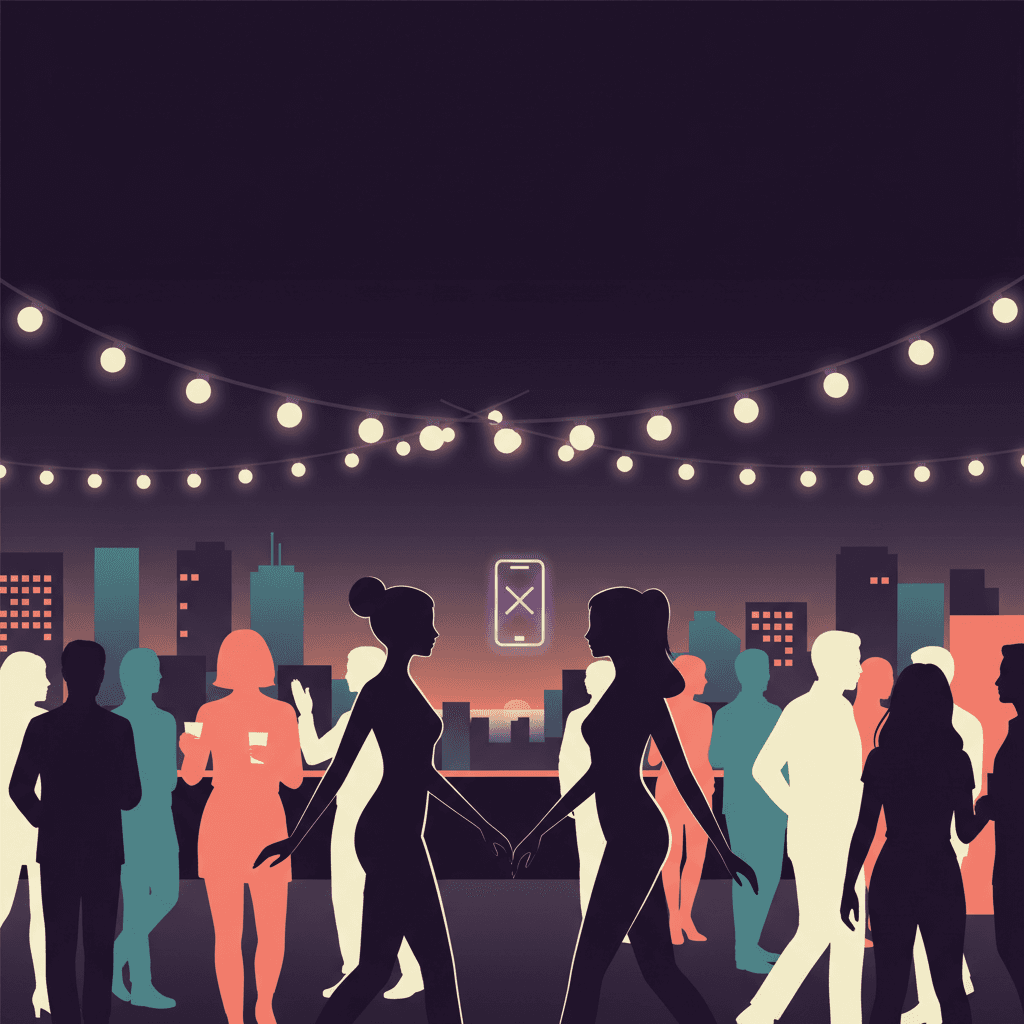
There's something about April and May that re-energizes the social scene in a way that even the most sophisticated algorithm can't fully replicate. Outdoor events come back. Rooftop bars fill up. Festivals kick off. The density of spring — the sheer number of places where people are gathering in good moods, under good light, with low-stakes socializing built into the environment — creates conditions apps can only approximate.
Spring dating energy is real and measurable. You're more likely to feel confident walking into a room when the weather cooperates, when the venue has a built-in social context (a trivia night, a cooking class, a rooftop happy hour), and when everyone around you is in a similarly open, receptive mood. Apps, for all their personalization features, cannot manufacture that shared energy.
This is the season where event-based dating has a structural advantage — not just because people are out and about, but because the events themselves lower the social stakes while raising the emotional ones. You're already somewhere worth being. Meeting someone there feels like a pleasant surprise, not a high-pressure mission.
What Event-Based Dating Actually Looks Like
If you've spent enough time on the apps to feel the friction, here's what the shift to event-based meeting actually involves — and why it works so differently.
Shared context from the moment you meet
When you encounter someone at a wine tasting or an outdoor film screening, you already have something to talk about. The event is your opener, your common ground, and your first shared memory — before you've even exchanged numbers. This removes the most awkward part of early dating: the blank-slate text conversation with someone you have zero context on. You don't have to perform interest. It's already there.
Attraction grounded in reality, not optimization
Photos lie. Or more generously — photos optimize. Everyone leads with their three best shots, perfect lighting, curated bio. When you meet someone in person at an event, you see how they actually interact with strangers, whether they're warm or guarded, funny or flat, present or on their phone. That's high-quality signal apps cannot give you, and it accelerates trust-building in a way that weeks of texting simply cannot.
Commitment signals that filter intent
Here's the underrated thing about RSVPing to an event: it's a small but real act of commitment that filters out low-intent browsing. If someone shows up to a singles mixer on a Thursday night, they made a deliberate choice. They didn't just swipe right while watching TV. That behavior reveals something about their readiness — and readiness is exactly what apps have consistently failed to surface.
Natural social proof
Events create social proof in real time. If you're curious about someone across the room, you can observe how they carry themselves in a group. Do people laugh with them? Are they kind to the bartender? Do they draw people in or hover at the edges? These signals take weeks to emerge in text-based dating. In person, you can read them in minutes.
How to Make Event-Based Dating Work for You
The shift from apps to events doesn't mean abandoning your phone. It means using it with more intention. Here's how to get the most out of the in-person opportunity.
1. Choose events with built-in icebreakers. Seated dinners, trivia nights, cooking classes, escape rooms — anything that gives people a structured reason to interact beyond standing near each other with drinks. When the event provides a shared task or topic, approaching someone feels natural rather than awkward.
2. Go with a friend, then split up deliberately. Going solo is great if you're comfortable with it, but going with one friend and then consciously separating gives you a social anchor without closing yourself off. Two people clustered together read as a closed unit. One person is approachable.
3. Become a regular somewhere. Repeated exposure is one of the most underrated factors in attraction psychology. If you commit to the same monthly dinner series, jazz night, or hobby meetup, you build familiarity with the same people over time. Familiarity generates comfort. Comfort creates the conditions for connection in a way that cold-approach never quite does.
4. Move the conversation forward in the room, not just to text. The best in-person interactions don't trail off into "I'll DM you." They end with a plan made right there: "There's a rooftop thing next Saturday — you should come." The momentum of a live event can carry directly into your next meeting, without the drop-off that happens when things move to asynchronous text.
5. Use tech to extend the event, not replace it. If you're at an event and there's an app that lets you discover and connect with other attendees in real time, that's a fundamentally different proposition than cold swiping into the void. Context-layered discovery — knowing someone was at the same gathering you were — changes the entire dynamic of a first message.
Apps like Hooked are built around exactly this: join an event, see who else is attending, match within that shared context. It's the social intelligence of an in-person gathering layered with the convenience of your phone — without the low-intent, high-volume churn of standard swipe mechanics.
The Loneliness Paradox of Swipe Culture
Here's the uncomfortable truth sitting at the center of modern dating: apps have made it simultaneously easier to encounter people and harder to actually feel connected. The volume is up. The depth is down. You can match with dozens of people in a week and feel more isolated at the end of it than when you started.
This phenomenon has been called the loneliness paradox of swipe culture — a state where constant social stimulation produces diminishing emotional returns. You're technically more "social" than ever, but the interactions feel thin. They don't accumulate into anything. The conversations don't go anywhere. The dates that do happen often feel like job interviews rather than genuine human encounters.
The antidote isn't to swipe better, optimize your bio harder, or subscribe to a premium tier. It's to get back into rooms with people. To let connection emerge from shared experience rather than mutual profile approval. To acknowledge that most of the best relationships anyone has ever had started somewhere real — a party, a class, a mutual friend's thing, a random night out that turned into a story you still tell.
What's Actually Working in 2026
The shift is already happening. Singles events, hobby meetups, rooftop socials, and experience-based outings are seeing surging interest from people who've hit a wall with apps. The spring social season is underway — outdoor venues are booked, rooftop bars are open, festivals are launching. The conditions are genuinely good right now.
The mechanics haven't changed: humans connect through shared experience, social proof, repeated exposure, and demonstrated intent. Apps tried to shortcut that process, and they succeeded at parts of it while failing at others. The fatigue you're feeling isn't a personal flaw — it's a rational response to a system that overpromised.
Dating doesn't feel broken when there are real stakes, real context, and real rooms to be in. Go find the rooms.
Related Articles
How to Meet Someone at a Wedding: A Single's Guide
Wedding season is prime time for singles. Learn how to meet someone at a wedding with practical, no-cringe tips for the cocktail hour, dance floor, and beyond.
Single at a Wedding? How to Actually Meet Someone
Being single at a summer wedding is a hidden dating goldmine. Learn how to meet someone, spark real connection, and turn a wedding moment into something more.
How to Meet Someone at a Wedding When You're Single
Flying solo to a wedding this season? Here's how to enjoy the night, meet people naturally, and maybe leave with more than cake — no awkwardness required.