
How to Meet Someone This Spring (Without the Apps)
Spring event season is officially here — rooftop bars, music festivals, and singles mixers. Here's how to ditch dating app fatigue and make real connections.
Spring is officially here, and if you spent the winter deep in app-scroll purgatory — endlessly swiping, matching, getting ghosted, repeat — you are not alone. Dating apps have not gotten better. The algorithm has not learned you. But something has changed: the season.
Rooftop bars are back. Festival season is spinning up. Outdoor mixers, spring flings, and warm-night social events are filling up calendars faster than anyone expected. And for the first time in months, the entire city is conspiring to put interesting, single people in the same physical space at the same time.
The opportunity is real. The question is how to actually take advantage of it — how to turn a crowded rooftop or a packed festival into a genuine, lasting connection instead of an awkward moment you replay in the car on the way home.
This guide breaks it down.
Why Spring Has a Social Superpower
There is a reason spring dating feels different from any other season. After months of cold-weather withdrawal, people are genuinely excited to be out. Attendance at social events spikes. Energy is higher. Strangers are more open, more talkative, more willing to lean into a conversation that starts from nothing.
This is not just vibes — it is basic social psychology. Shared novel experiences accelerate bonding. When two people are reacting to the same live set, the same absurd trivia question, or the same spectacular sunset from a rooftop, they create instant common ground that would take weeks of app messaging to approximate.
That rooftop party is not just a backdrop for meeting someone. It is the actual mechanism of connection.
The Problem With Spring and Dating Apps
Here is where things get frustrating: most people try to optimize spring dating by doubling down on the apps. Better photos from the beach trip. Profile bios updated with festival references. More swipes during lunch.
But the app experience does not change because the season does. You are still subject to algorithmic randomness, still judging and being judged on profile surface area, still watching matches go quiet after two messages. The spring energy you are feeling does not translate through a screen — because it cannot. It is experiential, and apps are definitionally not.
Swipe fatigue peaks right around the time the weather gets good. You can feel the contrast sharply: swiping indoors while the social world outside is buzzing. Something about that registers as deeply wrong, because it is.
The experiential dimension of connection — what it feels like to laugh with someone at a live show, to bond over a terrible drink at a new bar, to navigate a crowded festival together and find each other again — is completely absent from app-based meeting. You are not matching on chemistry. You are matching on a curated photo set and a bio someone agonized over for forty minutes.
How to Actually Work a Spring Event
Meeting people at events is a skill, and like most skills, it is mostly about removing the overthinking. Here is what actually works:
Choose Events Where the Format Does the Work
Not all events are equal for meeting people. A concert where everyone faces the stage in silence? Hard. A March Madness watch party where strangers are high-fiving over the same buzzer-beater? Easy.
Look for events with built-in social scaffolding — formats where interaction is expected and even encouraged: trivia nights, themed mixers, outdoor festivals with multiple gathering areas, wine or cocktail tastings, or any event where the activity itself gives you something to react to with the people around you.
The event format does 70% of the social lifting. Your only job is to show up and lean into it.
Position Yourself at Natural Conversation Points
There is a reason the bar is always the best place to meet people at an event. It is not the alcohol — it is the shared waiting. Shared logistics. Shared mild inconvenience. These create low-pressure entry points into conversation with zero social awkwardness.
At a rooftop bar, the railing (where people lean and look out at the view) is another natural gathering point. At a festival, the food truck line. At a watch party, the cluster near the screen between plays.
Find the spots where strangers are already standing near each other with no particular agenda, and plant yourself there. You will not have to manufacture the conversation — it will materialize.
Lead With the Moment, Not With Yourself
The worst opener at any event is a self-introduction. "Hi, I'm [name]" immediately puts social pressure on the other person — now they have to engage with you as a stranger before you have built any shared context.
The best openers reference the moment you are both in: "Is this lineup always this slow?" or "That last set was unexpectedly good" or "Do you know if they're doing another round of trivia?" These feel natural because they are natural. You are two people in the same situation, noticing the same thing.
From there, conversation flows. You have created a tiny shared experience before the real conversation even starts. That tiny thing matters more than any opener line you could rehearse.
Actually Be Present
This one sounds obvious, and it is the thing most people actually fail at. If you are at a spring event and you are mentally half-checked into your phone — texting your group chat about the event you are currently at — you are missing both the event and the person next to you who might have been interesting.
Presence is attractive. Engagement is attractive. The person who is actually watching the band, genuinely laughing at the thing, reacting to the crowd — that is who people notice and drift toward. Put the phone away for twenty minutes and see what happens.
Festival Season: A Category of Its Own
Festival season deserves its own section because the social dynamics are genuinely different — and, if you play it right, significantly better for meeting people than any bar or mixer.
Festivals like Coachella and their regional equivalents create a specific condition that is almost impossible to replicate: a self-selected community of people who all love the same things, all in the same place, for multiple days. Before you have said a word to someone at a festival, you already know several important things about them. You share taste. You both planned ahead and followed through. You are both in a good mood.
That is a substantial head start.
Festival-Specific Tactics
Use the between-set windows. The 15-20 minutes between acts are social gold. Everyone is moving, energy is transitional, and there is a natural prompt ready-made: "Where are you headed next?"
Find the chill zones. Every festival has areas where people sit on the grass, gather around art installations, or post up near secondary stages. These low-energy pockets are where real conversations happen — away from the crowd noise and pressure of the main stage.
Say yes to detours. The best festival connections happen when you are open to unexpected turns. Someone says "we're heading to the south stage, come with us" — that is how people end up at the same after-party and exchange numbers when the night is winding down.
Do not overplan your set list. A rigid schedule keeps you from the spontaneous overlaps that lead to meeting people. Hold your must-sees loosely.
Rooftop Season: The Most Underrated Dating Format
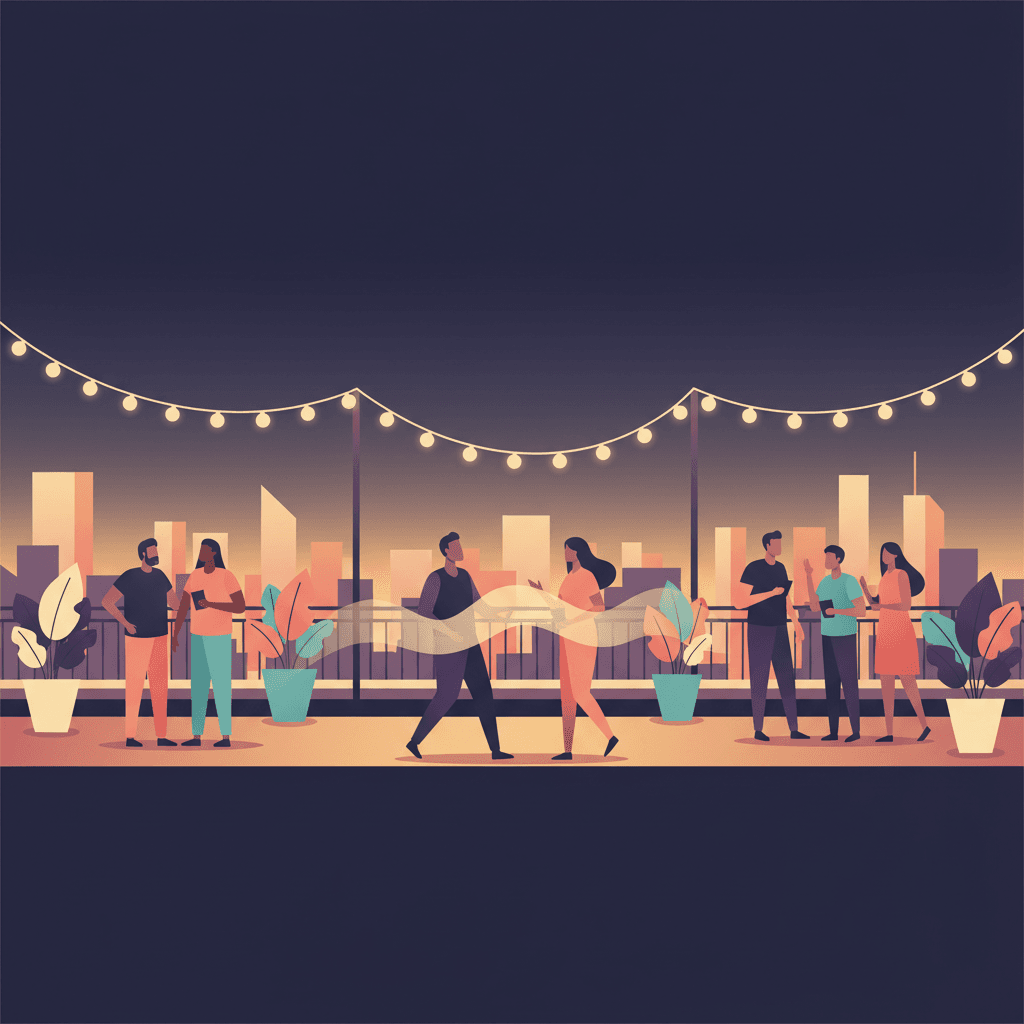
If festivals feel like a big lift, rooftop season is more accessible and nearly as effective. The rooftop bar is one of the best natural social environments for meeting strangers.
The view creates an immediate shared focal point and conversation starter. The open air reduces the anxiety of being "trapped" in a conversation that is not working. The sunset timing means most people arrive in waves rather than filtering in over hours, which creates a social energy spike right at arrival.
The view opener is genuinely effective and not at all corny: gesturing at the skyline and saying "I forget how good this looks until spring hits" to the person next to you is contextually perfect. It is emotionally resonant. It gives the other person an easy entry point that does not require them to evaluate you as a stranger on the spot.
Making the Follow-Through Happen
The most common failure mode at spring events is not the approach — it is the exit. You have a great conversation, you both know it was good, and then someone says "I'll let you get back to your friends" and it dissolves.
Do not let the moment die by default. If you have had a genuinely good conversation with someone, the follow-through does not need to be aggressive or awkward. It can be as simple as: "I'm going to grab another drink — what are you up to later tonight?" Or: "Do you come to these often? I'd send you the next one."
Exchange contact when the conversation is still warm — not as a desperate afterthought near the exit. The energy of the moment is your best asset. Use it while it exists.
The Mindset Shift That Makes Everything Easier
Here is the deeper reframe: spring event season is not a hunting ground. It is not a place to execute a social strategy. It is a place to genuinely enjoy your life while staying open to who else is doing the same thing nearby.
The people who actually meet someone at a spring event are rarely the ones who showed up with a game plan. They are the ones who were actually there for the music, the sunset, the absurdly specific trivia category — and happened to connect with someone who was also really, fully there.
Showing up fully — not performing, not running an approach, not scanning the room — is what makes you someone worth talking to. Apps train you to think of meeting people as a system to optimize. Spring events are a reminder that human chemistry does not work that way.
Lower the Stakes With Structured Social Events
If the idea of navigating all of this solo feels like a lot, that is completely normal. Events designed specifically for singles or social mixing have a built-in structural advantage: everyone knows why everyone else is there, which paradoxically makes it easier to relax.
When you are not trying to decode whether someone is single or interested, you can actually just have a conversation. Apps like Hooked are built for exactly this context — connecting attendees within a real event so you can discover who is there before you walk in, and match with people you have already met in person. The real-world interaction stays intact; the guesswork gets removed.
The Short Version
Spring is the best season to meet people — but only if you actually go out and meet them. The apps will still be there in June. The rooftop windows, the festival energy, the warm-night electricity — those are time-limited.
Go to the thing. Be genuinely present at the thing. Talk to the person standing next to you at the thing.
That is the whole strategy. And this spring, it is enough.
Related Articles
How to Meet Someone at a Wedding: A Single's Guide
Wedding season is prime time for singles. Learn how to meet someone at a wedding with practical, no-cringe tips for the cocktail hour, dance floor, and beyond.
Single at a Wedding? How to Actually Meet Someone
Being single at a summer wedding is a hidden dating goldmine. Learn how to meet someone, spark real connection, and turn a wedding moment into something more.
How to Meet Someone at a Wedding When You're Single
Flying solo to a wedding this season? Here's how to enjoy the night, meet people naturally, and maybe leave with more than cake — no awkwardness required.