
Spring Dating Season: Why Events Beat the Algorithm
Algorithm fatigue is hitting singles hard in 2026. This spring, discover why swapping swipe sessions for real-world events is the move everyone's making.
If you've opened a dating app lately and felt nothing — not excitement, not hope, not even mild curiosity — you're not alone. This particular flavor of exhaustion has a name: algorithm fatigue. And it's never been more widespread than right now, heading into spring 2026.
But here's the thing about spring: it has a way of shaking loose what isn't working. The weather breaks, the city wakes up, rooftop bars reopen, and suddenly there are places to be again. And increasingly, singles are choosing to be in those places — in person, phones in pockets — rather than grinding through another batch of algorithmically served strangers on a screen.
This isn't a nostalgia trip. This is a genuine shift in how smart, social people are approaching dating right now. And the reasoning behind it is hard to argue with.
Why the Algorithm Isn't Doing You Any Favors
At some point, most dating apps made a quiet promise: give us your preferences, your photos, your most charming opening lines, and we'll find you someone. The algorithm knows best.
The reality in 2026 looks different. Profiles have grown stale. Platforms have become saturated with inactive users, recycled faces, and the creeping suspicion that the app's incentives (keeping you subscribed) don't actually align with yours (finding someone worth deleting the app for). Reports of zero matches over weeks-long stretches are common. Features that once felt innovative now just mean sending the first message into a void.
Algorithms optimize for engagement, not for love. They reward novelty — the next swipe, the next notification — which is structurally at odds with the kind of slow, earned attention that real connections actually require. When the feedback loop is broken, you feel it. It shows up as scrolling without purpose, matching without momentum, and conversations that start with "hey" and end with silence.
The algorithm was never going to do the hardest part for you. It was never going to create chemistry, read a room, or give you a reason to look forward to Saturday night.
What Spring Actually Offers Singles
Spring social season isn't just a vibe — it's a structural advantage for anyone who wants to meet people. Here's what changes:
The Venues Reopen
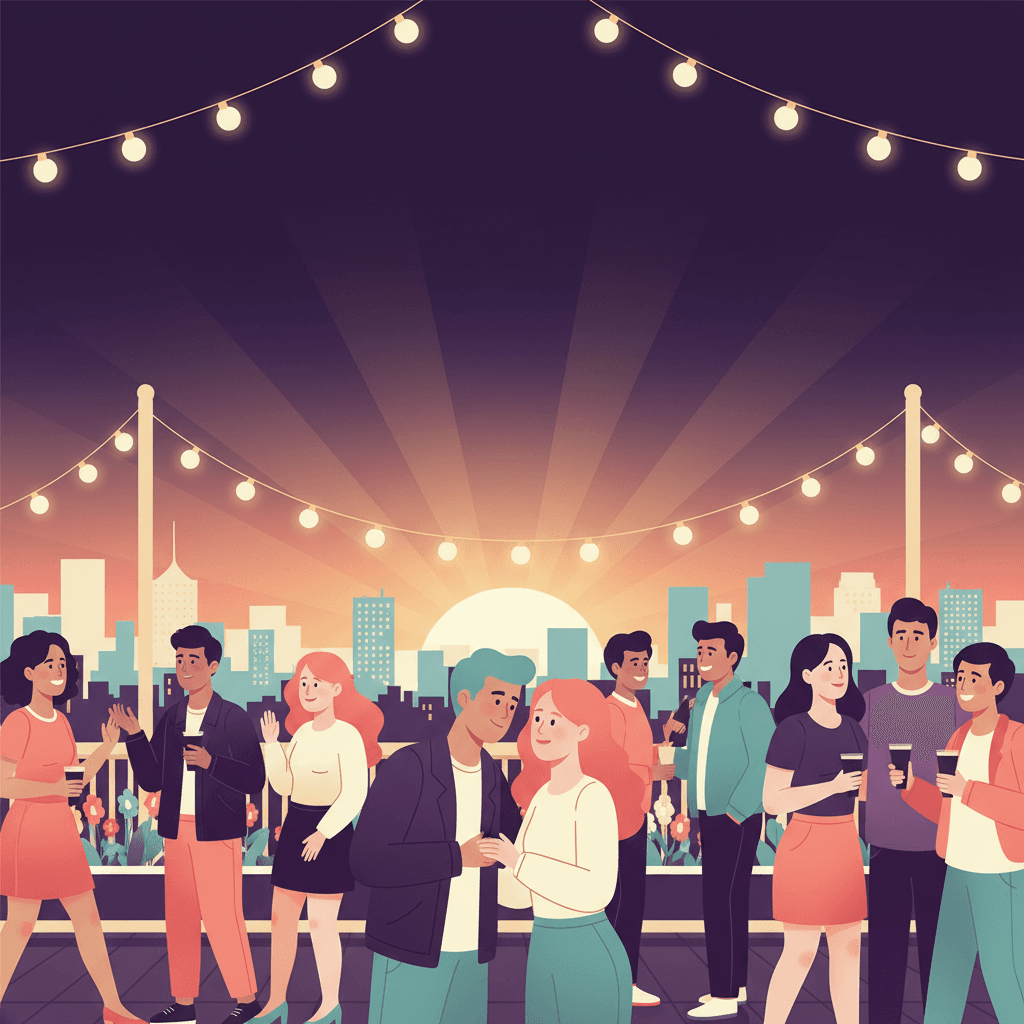
Rooftop bars. Patio pop-ups. Outdoor markets. Park hangouts that turn into impromptu plans. From late March through June, the urban landscape fills with exactly the kind of low-stakes, high-energy social environments where meeting someone new feels natural rather than transactional. You're not on a date; you're just out. That distinction matters more than people realize.
Group Energy Is High
People are more social in spring — not just individually, but collectively. The energy at a rooftop mixer in April is fundamentally different from a bar in January. People are more open, more willing to talk to strangers, more likely to be out with mixed groups of friends who are happy to expand the circle. The social momentum of the season works for you in a way no app notification ever could.
Real Events Are Everywhere
Singles mixers, speed dating nights, trivia competitions, wine tastings, March Madness watch parties, charity 5Ks, gallery openings — spring kicks off one of the richest event calendars of the year. These aren't manufactured excuses to meet people; they're actual things worth doing that also happen to put you in a room with other humans who had the initiative to show up.
The Science of In-Person First Impressions
Here's something no app can replicate: the full sensory experience of meeting someone. And it turns out that experience is doing a lot of work your profile photos can't.
Research consistently shows that in-person first impressions are processed through a complex cocktail of cues — voice tone, body language, how someone moves through a room, the way they laugh at something unexpected. These micro-signals are assessed almost instantaneously and with remarkable accuracy. You're not consciously cataloguing any of it; your brain just knows within minutes whether there's something worth exploring.
Photos and bios can't capture this. They can hint at it, and sometimes they do get it right — but the margin of error on a purely visual assessment is enormous. How many times have you matched with someone who seemed perfect on paper, met them in person, and felt... nothing? And how many times have you met someone at an event, someone you'd never have swiped right on, and felt unmistakably, inexplicably something?
In-person environments surface compatibility signals that profiles bury. They also remove the performance pressure of a first date — you're not on the spot in the same way when you're both just attending the same thing.
Events That Are Actually Worth Your Time This Spring
Not all events are created equal for meeting people. Here's a rough hierarchy based on what actually tends to work:
High-ROI Event Types
Curated singles events: Yes, they exist, and yes, they've gotten much better. The awkward church-basement variety has been largely replaced by hosted mixers at actual venues — cocktail parties with structured icebreakers, rooftop speed-friending events, sommelier-led wine nights. The shared acknowledgment that everyone's there to meet people removes the ambiguity and lowers the social stakes, paradoxically.
Skill-based group activities: Pottery classes, cooking workshops, salsa lessons, climbing gyms, improv classes. These work because the activity gives you something to talk about that isn't each other. You can be genuinely bad at pottery together, and that shared vulnerability is a better foundation for connection than any profile prompt answer.
Regular local events with recurring crowds: The trivia night at the bar two blocks over. The Saturday morning run club. The weekly neighborhood farmers market. Repeated exposure to the same people is underrated as a dating strategy. Familiarity builds comfort, and comfort is often where attraction develops.
Friend-of-friend gatherings: The house party, the birthday dinner that expands into a bar crawl, the group that keeps adding people. Being introduced through mutual friends is still one of the most reliable pathways to a real relationship — there's built-in social proof that apps can never manufacture.
Lower-ROI (But Still Worth Going)
Large festivals and concerts: Fun, obviously, but hard to have actual conversations. Better for bumping into someone who you then see again somewhere else.
Professional networking events: These can work, but the energy is divided between career and personal goals in a way that creates friction. Go for the genuine professional reasons and let any personal connection be a happy accident.
How to Actually Show Up at Events
Knowing which events to attend is only half the equation. Showing up in a way that creates real opportunities requires a bit of intentionality — not strategy, not game, just presence.
Go with a small group, not a big one. A group of two or three is ideal. It's social proof without being an impenetrable wall. Big groups tend to turn inward; small groups stay open to new people.
Have one real thing to say about the event. Not a pickup line — a genuine observation or question connected to where you are. "Is this your first time here?" is fine. "The DJ is making interesting choices" is better. Anything that shows you're actually present in the room rather than running a script.
Give conversations room to breathe. Not every interaction needs to end in a number exchange. Sometimes the best conversations at events are the ones where you talk for twenty minutes, laugh genuinely, and then drift — and then find each other again later without trying. That kind of natural orbit is a signal worth paying attention to.
Follow up on the energy, not the obligation. If you feel it, reach out. If you're reaching out because you think you should, don't. Forced follow-through is how you end up on a date you already know won't go anywhere.
The Group Event Advantage
One thing the best event-based daters have figured out: group settings do a lot of the emotional labor for you. When you meet someone at a singles mixer or a watch party, the context has already answered most of the awkward early questions. They're single (or at least open). They're social. They chose to be somewhere real rather than swiping from their couch. That's a meaningful filter that happens before you've said a word.
Group events also create something that first dates structurally can't: low-stakes multiple encounters. You can talk to someone for five minutes, go mingle, come back, and see whether the energy is still there. That rhythm mirrors how relationships actually develop in real social settings — through repeated, easy contact over time — rather than the artificial intensity of a two-hour one-on-one.
Apps like Hooked are built on exactly this insight — that events create a better context for discovery than algorithms do. When you're both at the same event, you already share something real before the conversation starts.
Making the Season Work for You
Spring doesn't automatically fix your dating life, but it does create conditions where the right moves have better odds. A few things worth doing before the season gets away from you:
- Audit your calendar. Are there events you keep meaning to attend but scroll past? Put one on the calendar now. Commitment reduces friction.
- Tell your friends you're open. Not in a desperate way — just let people know you're interested in being set up or invited to things. The network effect is real.
- Go somewhere new. Try the neighborhood you never quite get to, the bar your coworker keeps mentioning, the class you've been putting off. Novelty increases the chance of encountering someone outside your usual orbit.
- Use apps as a complement, not a replacement. If apps are working for you, keep using them — but don't let them substitute for getting out. The best outcomes tend to happen when your digital and real-world social lives reinforce each other.
The Shift That's Already Happening
There's something worth naming: the cultural mood around dating apps has shifted. A few years ago, saying you "met on an app" was almost the default. Now, more and more people are quietly proud that they met someone at an event, through friends, or just out somewhere. It's not a moral judgment on apps — they've connected millions of people and that's genuinely good. But the sense that real-world meeting has more inherent value is back, and it's changing how people are spending their social energy.
Spring is a natural reset point. The season cooperates. The venues cooperate. The collective mood cooperates.
The question is whether you're going to take the algorithm's word for it one more time — or whether you're going to go somewhere on Saturday and find out for yourself.
Ready to find events where real connections happen? Check out Hooked — the app built for event-based dating, not algorithmic matching.
Related Articles
How to Meet Someone at a Wedding: A Single's Guide
Wedding season is prime time for singles. Learn how to meet someone at a wedding with practical, no-cringe tips for the cocktail hour, dance floor, and beyond.
Single at a Wedding? How to Actually Meet Someone
Being single at a summer wedding is a hidden dating goldmine. Learn how to meet someone, spark real connection, and turn a wedding moment into something more.
How to Meet Someone at a Wedding When You're Single
Flying solo to a wedding this season? Here's how to enjoy the night, meet people naturally, and maybe leave with more than cake — no awkwardness required.