
Dating Apps Are Making You Lonelier — Here's What Works
Swipe fatigue is real — and research shows dating apps can actually amplify loneliness. Discover why it happens and how IRL events change everything.
There's a moment most single people know well. You've just finished a 20-minute scrolling session, swiped on maybe a dozen profiles, sent a few opener messages, and closed the app. And somehow — despite theoretically connecting with people — you feel more alone than when you started.
This isn't a glitch. It might actually be a feature of how these apps are designed.
The Loneliness Paradox of Dating Apps
Dating apps were supposed to solve loneliness. Download the app, find your person, live happily ever after. But a growing body of research is telling a different story: for many users, the constant swipe cycle functions less like a connection engine and more like a loneliness accelerant.
A 2023 study published in the Journal of Social and Personal Relationships found that heavy dating app users reported higher rates of social anxiety and lower relationship satisfaction than people who met partners through other means. Other research has linked excessive app use to decreased self-esteem, increased appearance anxiety, and — most striking of all — a paradoxical sense of isolation despite constant "connection."
Why? Because these apps were built to keep you swiping, not to help you actually find someone.
The Algorithm Doesn't Want You to Find Love
Here's the uncomfortable truth: dating apps' business models depend on you not finding a partner too quickly. The longer you swipe, the more data they collect, the more ads you see, and the more likely you are to pay for premium features. If everyone found their person on the first try, the app would lose its user base almost immediately.
This creates an inherent tension. Every design choice — the infinite scroll, the notification pings, the "Likes You" previews locked behind a paywall — is calibrated to pull you back in, not to push you toward the door with a date in hand. You're not a customer seeking love. You're an engagement metric in a quarterly earnings report.
The Asynchronous Trap
Then there's the problem of asynchronous communication. You match with someone. You send a message. You wait. Hours pass. Maybe a full day. They reply with something brief. You craft a response. The momentum slowly dies — not because there's no chemistry, but because the medium itself kills it.
Text-based getting-to-know-you is exhausting in a way that real conversation never is. You have to perform charm across a keyboard, guess at tone, manage multiple threads simultaneously, and somehow convey warmth through a screen. Research on cognitive load suggests that managing multiple ambiguous social interactions drains the same mental resources as high-stakes professional tasks. No wonder you feel depleted after an hour of app messaging.
The Profile Reality Gap
Profile curation has become a competitive sport — and not always in a good way. The expectation that you present a polished, aspirational version of yourself means the person who shows up to the date rarely matches the person who was on the screen. Everyone arrives slightly disappointed before a word has been spoken.
This sets up a dynamic where authenticity is, paradoxically, shocking. When someone turns out to be exactly who they said they were — same height, same energy, same vibe — it feels almost surprising. That's not a healthy baseline for starting a relationship.
Why In-Person Events Hit Differently
This is exactly why singles events, mixers, and IRL social gatherings have been quietly staging a comeback — and not just among people who've sworn off apps entirely. People who actively use apps are supplementing (or replacing) them with real-world experiences, and reporting better outcomes on both fronts.
The reason is simple: in-person interaction gives you information no amount of profile-scrolling can replicate.
Chemistry Is Physical and Immediate
Within the first thirty seconds of meeting someone in person, your brain is processing an enormous amount of data: their energy, body language, voice, the way they laugh, how they hold eye contact. This is the raw material of attraction, and it simply doesn't exist in a profile photo.
You can spend two weeks texting someone with whom you have zero in-person chemistry. Or you can spend two minutes at a singles mixer and know immediately whether you'd like to get coffee. The efficiency gap is enormous, even if it doesn't feel that way when you're anxiously selecting your main photo.
In-person conversation also benefits from something apps can never replicate: a shared context. You're both at the same event, navigating the same slightly chaotic energy, probably holding the same drink. That shared reality is the foundation of inside jokes, unexpected conversational turns, and the kind of "this is weirdly fun" feeling that's nearly impossible to manufacture over text.
Groups Reduce Rejection Anxiety
One of the biggest barriers to meeting people — especially for those newer to dating or re-entering the scene after a long relationship — is fear of one-on-one rejection. Dating apps actually amplify this anxiety. Every left swipe is a small sting. An unread message feels like a verdict on your worth. An unmatch after a week of conversation can genuinely ruin your afternoon.
Events reframe the social context entirely. When you're in a room with twenty or thirty other singles, you're not being evaluated in isolation. You're participating in a shared experience. The person who doesn't click with you at the drinks table might not be your type — and that's just fine. There's no notification, no read receipt, no waiting. You move on naturally, in real time.
This is especially true for people who feel intimidated by traditional dating. Group social settings normalize inexperience and awkwardness in a way that one-on-one app interactions simply don't. Everybody in the room is a little nervous. That shared vulnerability is actually one of the things that makes event-based connections feel more human.
You Meet People Who Are Actually Trying
There's a selection effect to in-person events that's easy to overlook: everyone who shows up made an effort. They got off their couch, got dressed, and decided to be social tonight. That pre-selection matters more than it might seem. People who invest real effort in meeting others tend to be more emotionally available and more likely to follow through than people who treat swiping as a passive, low-commitment activity.
How to Actually Get More Out of Events
Convinced it's worth trying but not sure where to start? Here's how to approach in-person events in a way that doesn't feel like homework.
Choose Themed Events Over Generic Mixers
"Singles event" as a category covers an enormous range. A generic cocktail party where strangers awkwardly hover near the bar is very different from a curated wine tasting, a cooking class mixer, or a trivia night designed with singles in mind. Themed events give you a built-in conversation starter, a shared activity, and a natural reason to interact with people you might not otherwise approach.
Prioritize events centered on something you genuinely enjoy. You'll meet people with at least one real thing in common from the start, which dramatically lowers the bar for opening conversations — and raises the likelihood of actually clicking.
Arrive Early, Not Fashionably Late
Counterintuitive but effective: get there before the room fills up. When an event is just starting, everyone is in the same slightly uncertain boat, and introductions happen more naturally. Once a space is packed and social clusters have formed, breaking in becomes significantly harder. Early arrival means you become part of the founding group — and people tend to remember the people they met first.
Use the Two-Minute Rule
Give yourself permission to wrap up a conversation after two minutes if it's not flowing. This sounds blunt, but it's actually kinder to everyone involved. A forced five-minute chat that goes nowhere leaves both people feeling awkward. A warm two-minute exchange — "Really great to meet you, I'm going to grab a refill" — leaves everyone feeling fine. You're not there to be endlessly polite. You're there to find genuine connection.
Have a Few Go-To Openers Ready
The small talk that opens conversations at events doesn't need to be original — it just needs to be genuine. A few questions that tend to spark real responses:
- "What's your connection to events like this — first time, regular?"
- "What do you do when you're not at singles events?"
- "What's the last thing you tried for the first time?"
These invite a story rather than a yes/no answer. Stories are where personality comes out, and personality is what you're actually there to discover.
Follow Up Specifically and Soon
If you connected with someone and exchanged contact info, don't wait three days to seem cool. Follow up the next morning with something specific that references your actual conversation: "Still thinking about that hiking trail you mentioned — which one was it?" Specificity signals genuine interest in a way that a generic "Great meeting you!" never will.
The Summer Window Is Right Now
If you've been meaning to get out more and meet people in person, the timing couldn't be better. Summer is the social season — outdoor events, rooftop parties, beach gatherings, graduation celebrations, and community mixers all multiply between now and September.
Summer also lowers social inhibition naturally. People are in better moods (sunlight genuinely matters to your brain chemistry), dressed more casually, and generally more open to spontaneous conversation. The seasonal energy creates an unofficial permission structure to be a little more outgoing than you might be in February.
Make a summer social plan. Be intentional about it the same way you'd approach a fitness goal. Identify two or three events per month that sound genuinely interesting. Put them in your calendar. Show up even when the couch sounds better. The people you meet in summer often become the social fabric of your fall — they invite you to things, introduce you to others, and gradually expand your world in ways no algorithm can predict or engineer.
How to Use Dating Apps Smarter
None of this means you need to delete your apps. They're a real part of how people meet, and dismissing them entirely would be impractical. But treating them as your primary social strategy — and expecting them to solve your loneliness — is where the disconnect happens.
Apps work best as a supplement to an active in-person social life, not a substitute for one. When you're already meeting people organically, app conversations carry less weight. You're not pinning your entire social hope on whether someone responds to your opener. That low-stakes dynamic actually makes you more confident on the apps too — and ironically, that confidence tends to produce better results.
Some newer platforms are rethinking this relationship entirely. Hooked builds the event experience directly into the platform, so that the digital connection comes after the in-person one, not instead of it. Meet first, match later — a small but meaningful shift in how dating technology can work.
The Bottom Line
Dating apps haven't failed you — but if you're feeling lonelier than you did before you downloaded them, that's information worth paying attention to. The swipe model was never designed to replicate the full complexity of human chemistry. It was designed to approximate it, at scale, with acceptable conversion rates.
Real connection is messier and less optimized. It involves showing up to a room full of strangers, making awkward small talk, and occasionally having a conversation that genuinely surprises you. It involves being seen — not curated, not filtered, not cropped for your best angle. Just actually seen, in real time, by another person who is also just trying to figure this out.
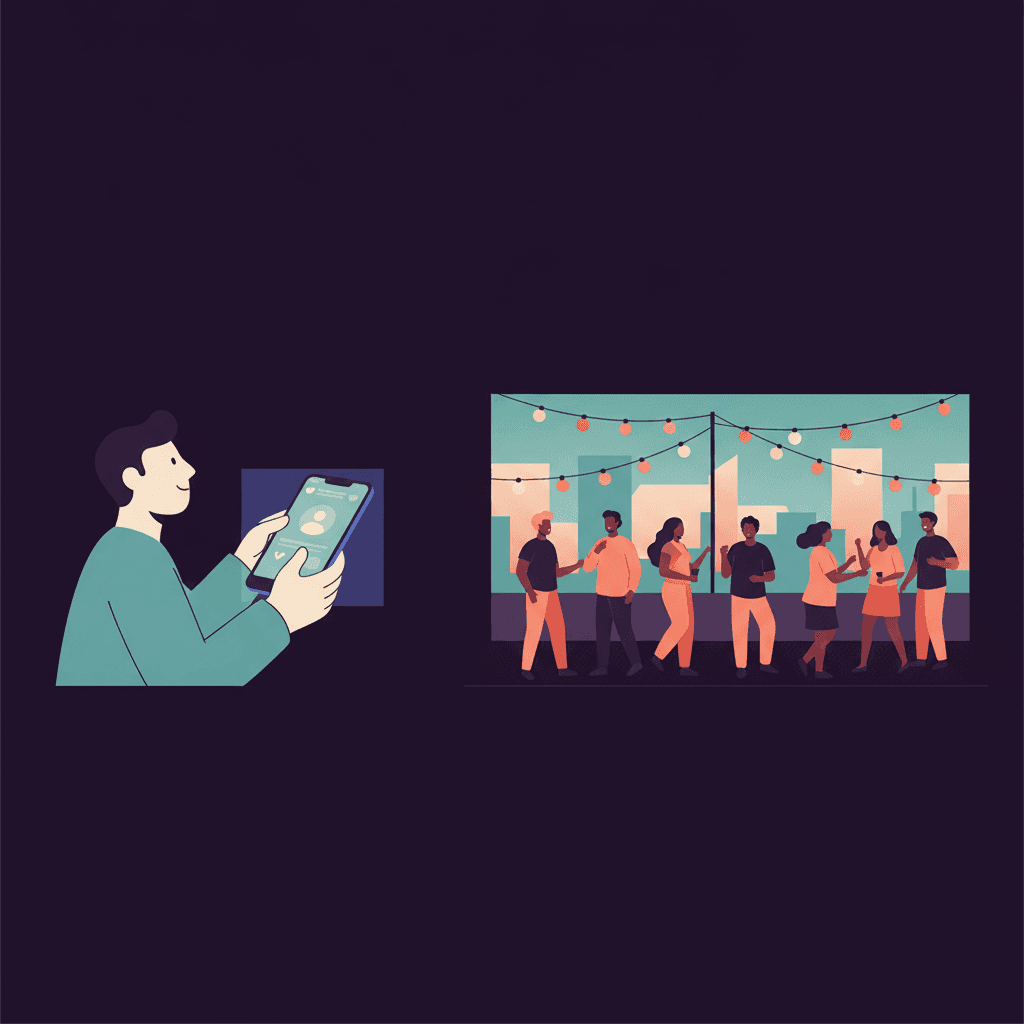
This summer, give yourself permission to put the phone down and go be in the world. The best match might not be a profile you scroll past at midnight. It might be the person standing next to you at a rooftop party, wondering the exact same thing you are.
Related Articles
How to Meet Someone at a Wedding: A Single's Guide
Wedding season is prime time for singles. Learn how to meet someone at a wedding with practical, no-cringe tips for the cocktail hour, dance floor, and beyond.
Single at a Wedding? How to Actually Meet Someone
Being single at a summer wedding is a hidden dating goldmine. Learn how to meet someone, spark real connection, and turn a wedding moment into something more.
How to Meet Someone at a Wedding When You're Single
Flying solo to a wedding this season? Here's how to enjoy the night, meet people naturally, and maybe leave with more than cake — no awkwardness required.