
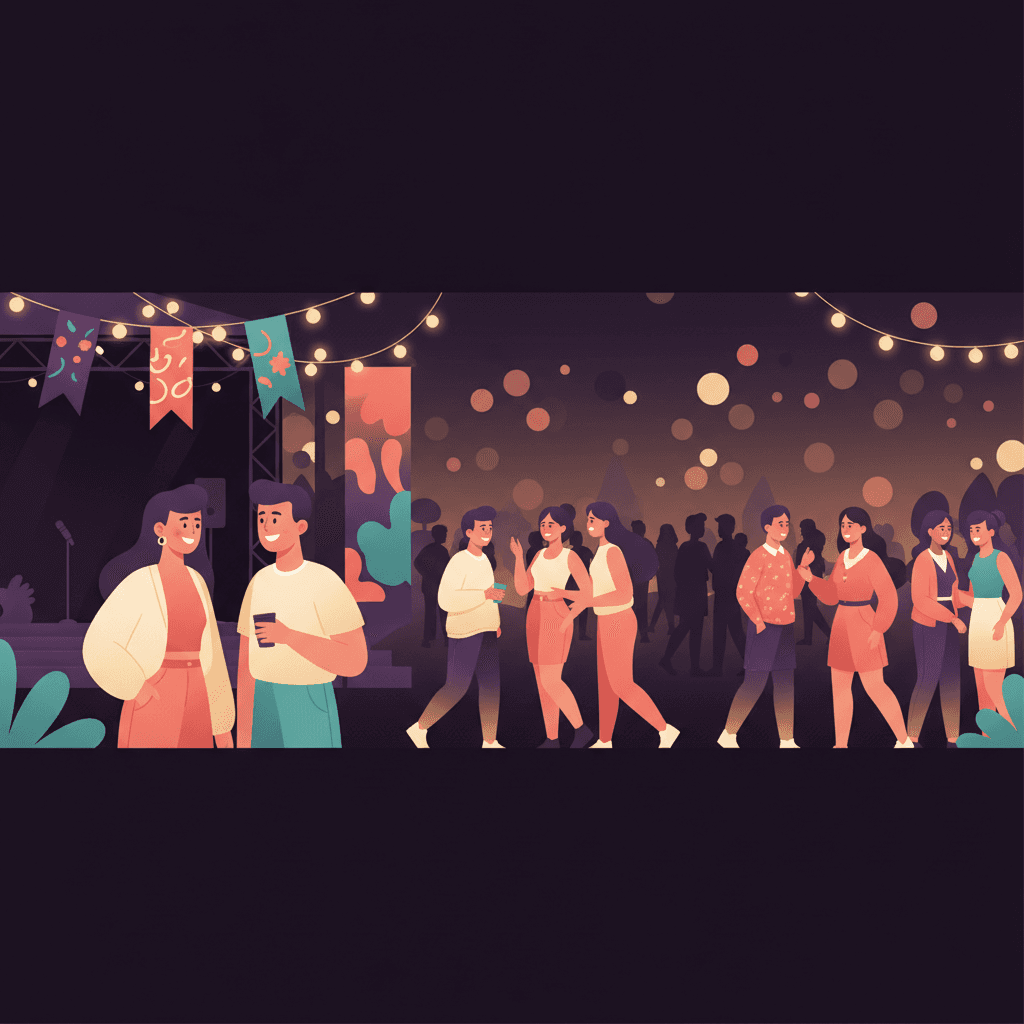
How to Meet People at Spring Festivals (Without Being Weird)
Festival season is here and you're surrounded by thousands of interesting strangers you'll never speak to. Here's how to actually change that.
Spring is here, which means two things: your vitamin D levels are finally recovering, and you're about to spend the next four months surrounded by thousands of interesting strangers — all of whom you'll never speak to.
Unless you change that.
Festival season is genuinely one of the best times of year to meet new people. Not because of some cosmic alignment, but because the social dynamics are actually in your favor for once. Everyone's in a good mood. There's built-in conversation fodder everywhere you look. The music is too loud for awkward silences. And nobody's staring at their phone pretending to be busy (well, mostly).
The problem isn't opportunity — there's plenty of it. The problem is that most people have spent so much time crafting their opening lines for dating apps that they've completely forgotten how to talk to someone standing right next to them. This is your guide to fixing that.
Why Spring Festivals Are Actually Perfect for Meeting People
Let's quickly address the elephant in the field: yes, it's slightly uncomfortable to introduce yourself to a stranger at a festival. And yes, you might get rejected. Neither of these things will kill you.
What makes outdoor events and festivals uniquely good for meeting people is the shared context. You're not two strangers awkwardly trying to justify why you swiped right. You're two people who both chose to be at the same place, at the same time, for the same reason. That's already a connection before you've said a word.
Psychologists call this the "shared experience effect" — when people go through the same event together, even passively, they feel a stronger sense of closeness afterward. A loud, chaotic festival actually lowers your social filter in the best possible way. Everything is new and stimulating, which means people are naturally more open and present.
Compare this to a first date at a coffee shop, where both parties are self-conscious, hyperaware of every pause in conversation, and internally auditing whether they're being charming enough. Festivals are the opposite. You're both just... there. The venue is doing half the work for you.
The Spring Events That Actually Work Best
Not all events are created equal for meeting people. Here's a quick breakdown of what the spring social calendar has to offer:
Outdoor Music Festivals
The obvious one. Festivals like Coachella and their regional counterparts create enormous social ecosystems where people are predisposed to being friendly. The multi-day format is especially good — by day two, you've seen the same faces enough times that saying hello feels natural rather than forced.
Rooftop Bars and Day Parties
Spring's sleeper hit. Rooftop venues have built-in conversation starters (the view, the weather finally being good, the fact that everyone seems inexplicably happier twelve floors up). The crowd skews slightly more social-by-intent than a regular bar, and the atmosphere is relaxed without being so loud you're lip-reading.
Watch Parties and Sports Events
March Madness watch parties, playoff events, outdoor screenings — any event where there's a shared focal point takes the pressure off conversation. Nobody expects you to perform. You just react to the thing happening and let the talking happen around it.
Pop-Up Markets and Food Festivals
Underestimated. People are in good moods (free samples, sunshine), moving at a relaxed pace, and the setup naturally creates shared commentary moments: "Is this actually worth the wait?" "Have you tried the [thing]?" Low-stakes social glue.
Before You Go: The Prep Work Actually Matters
Meeting people at festivals doesn't start at the festival. It starts before you leave the house.
Know the Venue Layout
Look up the event map. Know where the main stages are, where the food vendors cluster, where the chill-out zones are. This matters for two reasons: you'll move with confidence instead of looking lost, and you'll know where people naturally linger. The food and drink areas are your best friend. People hang around there longer than anywhere else. They're already waiting, already relaxed, and already looking for something to occupy their attention. That something can be a conversation with you.
Come With an Opener, Not a Script
You don't need to rehearse a monologue. You need exactly one question or observation that's relevant to the moment. Something like:
- "Have you seen [Band Name] before — worth fighting to the front?"
- "Is that actually good or is it just good because we've been standing for four hours?"
- "First time here? I'm trying to decide if the second stage is worth ditching the headliner."
Notice what these have in common: they're all context-specific and they invite a short, easy response. You're not asking someone to evaluate your personality. You're just starting a low-stakes conversation about something you're both already experiencing.
Dress Like You, Not Like a Try-Hard
Wear something that reflects your actual personality. Not only will you feel more confident, but it gives people something to comment on. A distinctive hat, a band tee from someone unexpected, festival gear that signals your actual taste — these are passive conversation starters. If you do it right, people will approach you.
At the Festival: How to Actually Talk to People
Position Yourself Strategically
The people who meet the most people at events are almost never the ones pushing to the front of the crowd. They're the ones who stake out spots in the natural flow of the event — near the sides of stages, around the perimeter of food areas, or at spots where people stop to catch their breath.
If you're watching a performance from the back or side, you're in ideal social territory. People around you aren't totally consumed by the show and are more open to a casual exchange.
Read the Energy Before Approaching
Not everyone at a festival wants to be social. Some people are in their own world, headphones in (a universal "leave me alone" signal), or clearly having a private conversation. Don't interrupt those.
Look for people who are standing near you and looking around, making brief eye contact and then looking away, or reacting to something and glancing around to share the moment. That last one is gold. When someone laughs at something and looks around — they're looking for someone to share it with. Be that person.
The Group Approach
Going up to a solo person is simple. Approaching a group feels more intimidating, but it's often more productive — groups have more energy, and meeting one person in a group means you now have an "in" to their whole social bubble for the rest of the day.
The trick with groups is to address the group, not single someone out immediately. Start with a comment directed at everyone, let the conversation develop naturally, and if you click with someone in particular, that connection will establish itself without you engineering it.
How to Keep the Conversation Going (Without Killing It)
Ask Better Questions
The worst question you can ask at a festival is "so what do you do?" It immediately turns a fun, in-the-moment connection into a job interview. You're at a festival — not a LinkedIn mixer.
Instead, ask questions tied to the shared experience:
- "If you could only catch three acts today, which three?"
- "What's your honest take on this place — worth the hype?"
- "Are you here with a big group or just a few people?"
That last one matters because it naturally opens the door to either joining their plans or inviting them to join yours.
Don't Overstay Your Welcome
This might be the most important social skill at events: know when to wrap up a conversation and leave on a high. Five minutes of great conversation is worth more than thirty minutes of increasingly hollow filler.
"I'm gonna go grab [thing] but it was really nice meeting you — are you going to be around later?"
That's the whole move. You've ended on a positive note, left them wanting more, and opened the door for a second interaction that will feel warm and familiar instead of starting over cold.
Actually Exchange Information
If you've had a good conversation and there's genuine mutual interest, don't leave it to fate. Ask to swap numbers or connect. Frame it as a continuation of the fun you're already having: "We should find each other again later" or "Text me if you end up at the evening session."
People are far more receptive to this at events than in most other contexts, because the shared experience has already established trust and rapport before you've even asked.
The Mindset Shift That Changes Everything
Here's the thing nobody tells you about meeting people at events: the goal shouldn't be to collect contacts. The goal is to have a good time and let connections happen as a natural byproduct.
When you're genuinely enjoying yourself — when you're not on a mission to find a date or work the room — you become magnetic. People are drawn to people who are present and having fun, not people who are visibly running a social playbook.
This is also why event-first ways of meeting people tend to produce better outcomes than cold swiping. Apps like Hooked are built around this exact idea — connecting people within the context of real events they're both attending, so the shared experience does the heavy lifting before conversation even starts. Whether you use an app for it or just show up with an open mindset, the principle is the same: shared context beats cold outreach every time.
Things That Will Definitely Not Work
Because balance demands it:
Waiting for the perfect moment. There is no perfect moment. There's a moment, and then another moment, and then the festival is over and you drove home alone listening to a podcast about how to be more social.
Being on your phone the whole time. You're at a festival. The algorithm will still be there when you get back. The person next to you will not.
Opening with appearance-based compliments. It's a festival. Everyone looks chaotic. Lead with something contextual — see the opener section above.
Staying locked in your friend group. This is the social equivalent of going to a restaurant and eating food you brought from home. You're there. Use the venue.
Treating every interaction as a screening process. Not everyone you talk to is going to become a close friend or a romantic interest. That's fine. Some conversations are just good conversations. Those are also worth having.
Go Have an Actual Spring
Festival season is short. The window between "too cold to stand outside for four hours" and "too hot to stand outside for four hours" is narrower than it always seems in April. The conditions are ideal. The energy is high. The people are there.
The only question is whether you're going to actually meet any of them, or just take a lot of videos of the crowd and scroll through them later wishing you'd talked to someone.
Get out there. The event is just a venue — you're the thing that makes it worth attending.
Related Articles
How to Meet Someone at a Wedding: A Single's Guide
Wedding season is prime time for singles. Learn how to meet someone at a wedding with practical, no-cringe tips for the cocktail hour, dance floor, and beyond.
Single at a Wedding? How to Actually Meet Someone
Being single at a summer wedding is a hidden dating goldmine. Learn how to meet someone, spark real connection, and turn a wedding moment into something more.
How to Meet Someone at a Wedding When You're Single
Flying solo to a wedding this season? Here's how to enjoy the night, meet people naturally, and maybe leave with more than cake — no awkwardness required.