
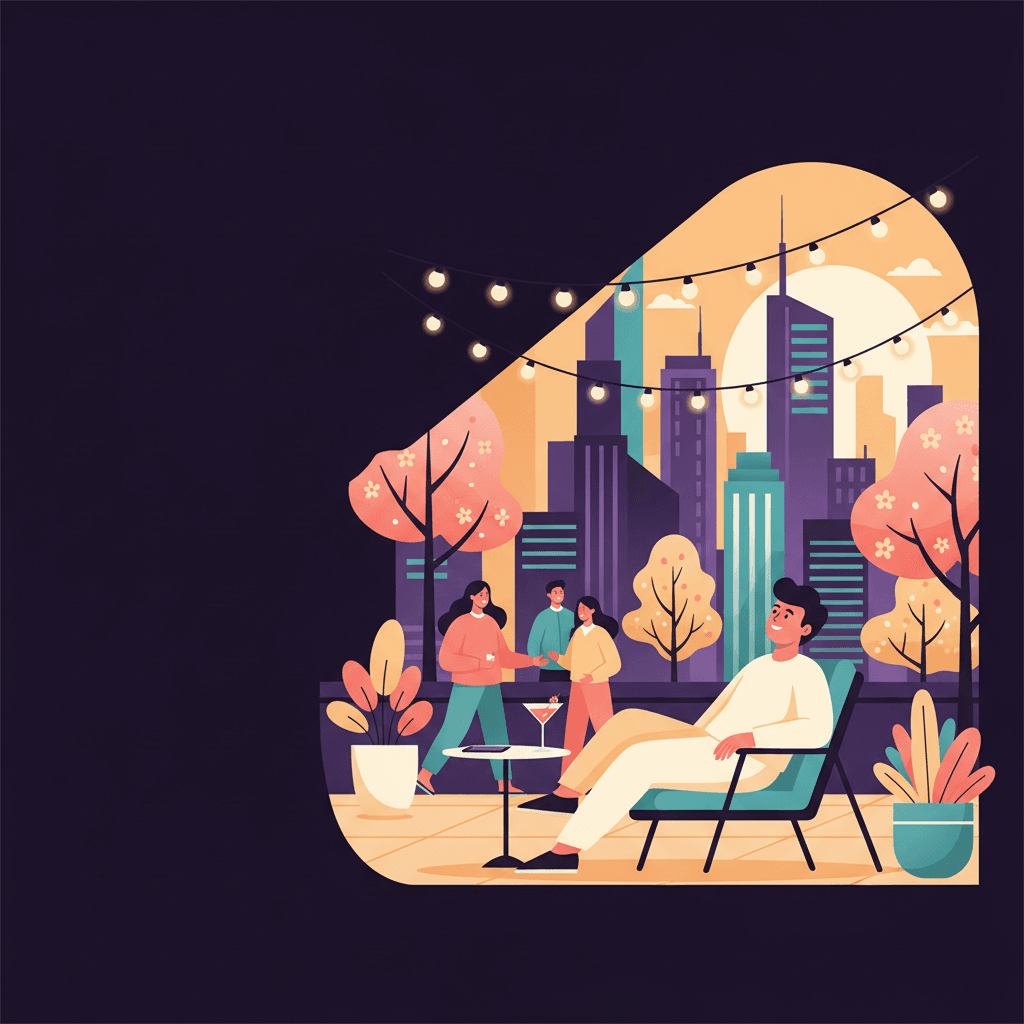
Dating App Burnout: The Spring Reset You Actually Need
Swiping yourself into oblivion? You're not alone. Here's why spring is the perfect season to quit dating apps and actually meet real people at events.
Spring is here, the rooftops are open, and you're still lying in bed at 11pm swiping on strangers who look vaguely like their photos from 2019. We need to talk.
Dating app burnout is real, it's widespread, and it has a peculiar way of peaking right as the weather gets beautiful enough to do literally anything else. You know the feeling: you've seen the same 40 people cycle through your stack so many times you've started mentally categorizing them. There's Yoga Mat Guy. There's Inexplicable-Tiger-Photo Woman. There's the one who only communicates in GIFs. Your thumb moves on autopilot. Your heart has checked out. And yet — you keep scrolling.
This spring, you don't have to.
What Dating App Burnout Actually Feels Like
Let's be honest about the symptoms before we talk solutions. Dating app burnout isn't just "I'm tired of swiping." It's a specific kind of soul-level fatigue that creeps up on you slowly and then announces itself all at once — usually when you realize you've been half-watching Netflix and half-reviewing profiles for two hours and feel measurably worse than when you started.
The signs are recognizable:
- You open the app out of habit, not hope. The dopamine hit from a new match that used to feel exciting now barely registers.
- Every conversation feels like a job interview. "What do you do for fun?" "Where are you from?" Yawn.
- You've become cynical about photos. You're mentally docking points for lighting, second-guessing group shots, and performing accidental reverse image searches.
- The thought of another first date at a wine bar makes you want to fake your own death.
- You're exhausted but can't stop, because what if you miss someone great? (You won't. You need a break.)
Sound familiar? You're in very good company. This isn't a personal failing — it's a design feature. Dating apps are engineered to keep you swiping, not to help you actually stop needing them. There's a reason the delete button is buried six menus deep.
Why Spring Is the Perfect Time to Break the Cycle
Here's some actually good news: you picked the best possible season to have this crisis.
Spring does something measurable to human social behavior. The days get longer, the patios open up, people crawl out of their winter apartments blinking into the sunlight and suddenly want to do things. Music festivals kick off. Rooftop bars fill up. Neighborhood markets, outdoor concerts, social gatherings — the whole calendar explodes between March and May with reasons to be around other humans in an entirely unmediated way.
This isn't just vibes, either. Winter is genuinely isolating in ways that push people toward apps as a substitute for social contact. When that isolation lifts, you suddenly have options that weren't available four months ago. The person you might click with is now at the farmers market, at the outdoor concert, at the very event you're currently considering skipping to stay home and swipe.
Spring is, historically, when people meet. Not because of pheromones (probably) but because everyone is outside and in a good mood at the same time, which turns out to be surprisingly powerful social chemistry.
The Swiping Trap: Why Online Dating Struggles to Compete With Real Life
Here's the honest problem with app-first dating right now: the medium is working against you.
When you swipe on someone, you're making a decision based on a curated highlight reel — the best photos from the last three years, a 300-character bio designed to be inoffensive to the maximum number of people, and whatever mysterious algorithm decided you two should exist in each other's queues today. The whole thing is optimized for visual first impressions, which means it systematically filters out exactly the kind of thing that tends to create actual chemistry: shared experience, energy, the way someone laughs too loudly at their own jokes, the fact that you both just had the exact same take on the headliner.
Real-life encounters are messy and inefficient and wonderful in ways that apps structurally cannot replicate. The conversation that starts because you're both waiting at the same taco stand. The spark you'd never have predicted from a profile. The implicit vetting that comes from knowing this person shows up to things — because they showed up to the same thing you did.
The Confidence Paradox Nobody Talks About
There's another layer here worth naming: apps can quietly erode your social confidence over time, and they do it in slow motion so you don't notice.
When your primary mode of meeting people becomes a platform that evaluates you with a binary swipe, it's hard not to internalize the metrics. You start optimizing your profile photo instead of developing your personality. You get better at typing witty openers and worse at actually holding court in a room. The feedback loop trains you for app-dating, not human-dating — and those are genuinely different skills.
Going to an event — especially if you haven't done it solo in a while — might feel nerve-wracking. That's completely normal and also a good sign. The mild anxiety you feel before walking into a room where you don't know everyone is your nervous system doing its job: preparing you for something real. That feeling disappears within about ten minutes, and what replaces it is usually something that looks a lot like being alive.
How to Actually Meet People at Spring Events (Without Being Weird About It)
Okay. So you've muted the notifications (or deleted the apps entirely — respect). Now what? Showing up is step one; here's what actually works once you're there.
Go to Things Twice
This is the single most underused tactic in real-life socializing and it's almost embarrassingly simple. The first time you attend any recurring event — a weekly trivia night, a monthly singles mixer, a regular rooftop happy hour — everyone is mostly a stranger and you're all doing that awkward calibration thing. The second time, you're a regular. People remember you. Conversations pick up where they left off. Show up twice. That's the whole tip.
Have One Good Question Ready
You don't need a repertoire of clever openers. You need one genuine question that isn't "what do you do?" Ask about the event itself — how they heard about it, whether they've been before, what they thought of the last one. Shared context is the easiest conversation starter in existence and it's right there, free, waiting for you.
Stop Trying to Make Things Happen Immediately
Apps have trained us to expect a yes/no outcome fast. Real-life social interaction doesn't work that way, and trying to force it is exactly what makes people seem intense. Sometimes you have a great twenty-minute conversation with someone at an event and nothing "happens" — and then you run into them again three weeks later and something does. Plant seeds. Be memorable without being a lot. You're playing a longer game now, and the longer game is actually more fun.
Let Tech Work For Real Life, Not Instead of It
If you do use your phone in the dating context, use it in ways that get you off your phone. Some platforms are built around real events and let you discover who else is attending before you arrive — think of it as a social layer on top of real-life gatherings rather than a replacement for them. Hooked works exactly this way: you join an event, see who else will be there, and any connection you make is grounded in the fact that you're literally in the same room. It's a fundamentally different dynamic than cold-swipe-cold-message-cold-date.
Spring Events Worth Actually Attending
The seasonal calendar is genuinely stacked. If you're in a major city, your options include:
Rooftop Bar Season: The rooftop opens and suddenly everyone is more attractive and more talkative. It's science, or at least very good lighting. Look for rooftop happy hours, rooftop listening parties, anything that happens to be vertical.
Music Festivals and Outdoor Concerts: Festival season is one of the best contexts for meeting people because you're already sharing an experience. You have infinite conversation material, and you can immediately tell whether someone is fun at a music event — which is meaningful information about whether they're fun in general.
Singles Mixers and Intentional Events: The stigma here is completely overblown. People who show up to a singles event are people who want to meet someone and aren't too precious to admit it. That self-awareness is a green flag, not a red one. You will not be the only one there who came alone. Everyone came alone. That's sort of the point.
Neighborhood Markets and Pop-Up Events: Lower stakes than anything called a "singles event," but surprisingly high conversion for actual connection because they attract people who are rooted in a community, care about local things, and aren't in a hurry. Bonus: you can eat while you're nervous, which helps.
Fitness Classes and Recreational Sports Leagues: Recurring, context-rich, and you see people at their sweaty-but-energized best. Adult recreational sports leagues in particular have a statistically weird rate of people meeting partners — probably because shared suffering bonds humans in ways that a curated profile simply cannot.
Making Peace With Offline Dating's Timeline
The last thing to address is the timeline anxiety, because it's real and it's the main thing that drives people back to apps within a week of deleting them.
Apps offer an illusion of control: you can always be doing something. You can swipe at 2am when you can't sleep. You can send thirty messages in a day. The activity creates a feeling of progress even when it's producing absolutely nothing but thumb calluses.
Real-life dating is slower and less legible. You went to three events and didn't meet anyone obvious. Was that wasted time? No — it was time you spent being a person out in the world, building a social life, becoming someone who has actual things to talk about. The connection you make at event number four lands in richer soil because of it.
The people who genuinely thrive at in-person dating are the ones who enjoy the events independent of the dating outcome. That sounds like a self-help platitude but it's actually functional strategy: if you're at the rooftop bar because you like rooftop bars, you're relaxed, you're present, you're magnetic. If you're at the rooftop bar with the energy of someone trying to complete a quota, people can smell it from across the room.
Go for the spring. Meet people as a side effect.
The Actual Spring Reset (A Practical Version)
Here's a simple, non-overwhelming version of what "taking a break from apps this spring" looks like in practice:
- Mute the notifications on every dating app. You don't have to delete them dramatically. Just stop letting them summon you like a needy ex.
- Say yes to two events you'd normally skip. One per week to start. Anything where strangers are present and the setting isn't your couch.
- Talk to three people at each event. Not to date them. Just to practice being a person in proximity to other people.
- Give it four weeks before you evaluate anything. One month. You can do one month.
- Notice how you feel — not whether you met someone, but whether you feel better. Lighter. More like yourself.
If you feel better — and most people do — you'll have your answer about where your energy belongs this season.
Spring is here. The patio is open. The familiar carousel of profile photos will still be on your phone if you need it. But maybe this year, you don't.
Ready to meet people at real events this spring? Download Hooked and see who's going to the events near you.
Related Articles
How to Meet Someone at a Wedding: A Single's Guide
Wedding season is prime time for singles. Learn how to meet someone at a wedding with practical, no-cringe tips for the cocktail hour, dance floor, and beyond.
Single at a Wedding? How to Actually Meet Someone
Being single at a summer wedding is a hidden dating goldmine. Learn how to meet someone, spark real connection, and turn a wedding moment into something more.
How to Meet Someone at a Wedding When You're Single
Flying solo to a wedding this season? Here's how to enjoy the night, meet people naturally, and maybe leave with more than cake — no awkwardness required.