
Why You Feel Lonely at Crowded Events (And What to Do)
You're surrounded by people yet somehow feel completely alone. Here's why event loneliness is a design problem, not a personality flaw — and how to fix it.
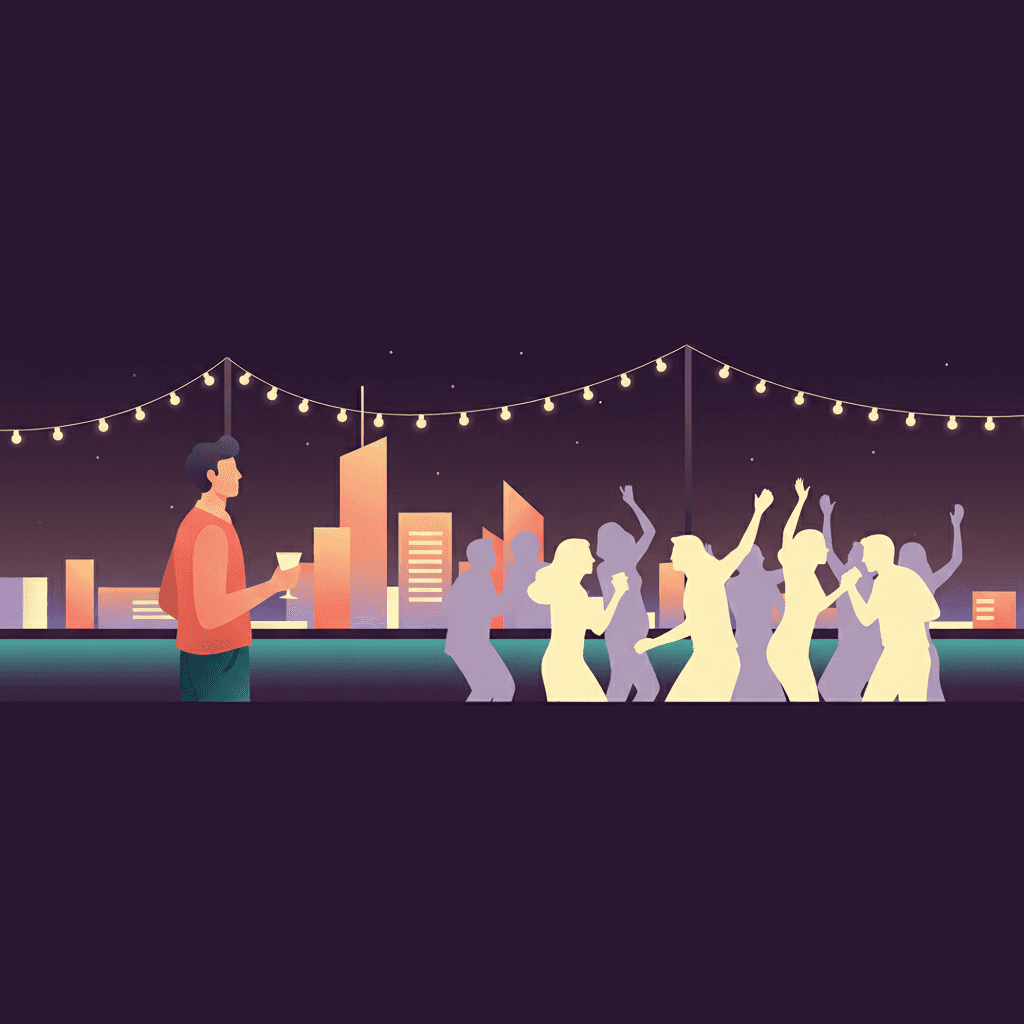
You walk into the party. Music is going. People are laughing. Someone hands you a drink. You glance around and think, great, another evening of standing slightly too far from every conversation.
Congratulations — you've just experienced event loneliness, and you are in extremely good company. The weird, under-discussed truth about social events is that physical proximity to other humans is not the same thing as connection. You can be surrounded by a hundred people and feel more isolated than you do on your couch watching something nobody recommended to you. That's not a personality flaw. That's a design flaw.
Here's why it happens, and — more importantly — what you can actually do about it.
The Problem: Crowds Were Never Built for Connection
Here's a hot take that most event marketing would rather you didn't think about: large, unstructured social gatherings are genuinely terrible places to meet people. They were designed for atmosphere, not access.
Think about what a typical party, bar night, or summer mixer actually offers you: ambient noise that makes conversation physically painful, social clusters that formed before you arrived and have no structural reason to open up, and an exit you spend the whole night eyeing.
The usual advice — "just put yourself out there!" — ignores the fact that there's no mechanism for "out there." You don't need more confidence. You need better infrastructure.
This is why people leave events feeling drained and vaguely disappointed: the promise was meet people, but the format delivered stand near people. There's a meaningful difference.
Why You Feel Lonely Even When You're "Social"
The Performance Trap
Social events, especially in your 20s and early 30s, carry an invisible expectation that you will be visibly having a good time. So instead of actually connecting with anyone, you spend your energy looking connected — nodding along to music you're not feeling, laughing a half-second after the joke lands, holding your drink like a prop.
This is exhausting. And it's also why you go home wondering why you never meet anyone "real." You weren't real either. Nobody was. Everyone was performing ease.
The antidote isn't to suddenly stop caring what people think (good luck with that). It's to find environments where the performance pressure drops by default — where something else is the focus.
The Crowd Dilution Effect
Counterintuitively, bigger events often produce worse social outcomes than smaller ones. When the crowd is large, there's always the implied option that someone better is just around the corner. People don't commit to conversations the same way. The mental math is: why invest in this when I could be investing in literally anyone else in this room?
Smaller gatherings — or events with built-in structure that groups people into smaller clusters — short-circuit this. When the pool is contained, you actually pay attention to who's in front of you.
The Shared Context Void
Small talk is painful primarily because it lacks stakes. "What do you do?" is not a question — it's a placeholder while both parties wait to discover whether there's any reason to keep talking.
Contrast this with conversations that arise organically from shared context: you're at the same show, you just watched the same thing happen, you both clearly showed up for the same reason. Suddenly you have something to talk about that isn't just competitive biography-swapping. The context does the heavy lifting.
This is one reason why people who meet at concerts, hiking groups, cooking classes, or sports leagues tend to stay in touch — the event itself gave them a foundation.
What Actually Helps: Practical Moves for Real Humans
Arrive with Intent, Not Hope
"Maybe I'll meet someone interesting" is the most passive possible approach to a social event, and it produces passive results. Before you go, identify one specific thing you're genuinely curious about — a topic, a type of person, a question you'd actually love to discuss. Walk in with that in mind.
This sounds small, but it reframes the entire experience. You're no longer waiting to be discovered. You have something to look for.
Volunteer for the Awkward Moments
The most reliably interesting conversations at events happen in the least glamorous spots: the line for drinks, the coat check, the weird corner where someone's trying to figure out if the appetizers are still coming. These are low-stakes, time-bounded interactions. Nobody expects anything. That's why they work.
Stop trying to break into groups that are already in full swing. Find someone who also looks like they're between conversations. You're both in the same boat. That's already something.
Use Structure When You Can Find It
If an event has an organized component — a game, a guided activity, a speed-networking segment, icebreaker questions posted on a board — don't roll your eyes at it. Structure is doing you a favor. It gives you a reason to talk to someone specific, a shared task to reference, and a natural off-ramp ("okay that round's done") that removes the pressure of having to end conversations gracefully.
Events that are built around an activity, not just an atmosphere, consistently produce better connection outcomes. This isn't just anecdote — it's why people are increasingly drawn to experiences like pottery nights, trivia, fitness classes, or event-based apps like Hooked that let you discover who else is at an event and actually start a conversation with context.
Stop Trying to "Work the Room"
"Working the room" is advice from the networking era of the 2000s that has aged very poorly. It optimizes for quantity of interactions and produces none of any quality. Collecting business cards nobody asked for is not the same as making a connection.
Give yourself permission to have one genuinely interesting conversation per event and call it a win. One is more than most people achieve. One conversation where you both lean in slightly and lose track of time is worth twelve polite fifteen-second exchanges.
Exit Early, on Purpose
Here's counterintuitive advice: leaving before the event fully peaks often leads to better outcomes than staying until it dies. You leave while the energy is good and the memory is positive. You don't overstay the welcome of a conversation. And critically, you go home not feeling wrung out — which means you'll actually want to go to the next one.
Event loneliness is often compounded by the pressure to stay and make it count. But connection doesn't have a minimum time requirement. If you've had one real conversation and you're ready to leave, leave. You did the thing.
Early Summer Is Actually Your Best Bet
If there's a good time to test all of this, it's right now. Memorial Day parties, graduation gatherings, rooftop happy hours, outdoor festivals — early summer is peak event season, and early summer events tend to carry a specific quality of openness. People are newly energized. There's seasonal optimism in the air. The excuses for not going out are temporarily suspended.
This is the time to experiment with intentional attendance — choosing events where you have genuine interest in the activity or the crowd, showing up with a real question in your head, and giving yourself permission to leave if it's not working.
Choosing Better Events
Not all events are created equal. Before committing your evening, ask a few quick questions:
- Is there an activity, or just an atmosphere? Activities give you something to do besides scan the room.
- Do I know why these people are here? Shared purpose > random proximity.
- Is the venue actually conducive to talking? Deafening bass is a social mixer's natural enemy.
- Is the crowd size right? Under 50 people tends to produce more genuine mingling than 300-person galas.
The best events for actually meeting people are often mid-size, activity-anchored, and somewhat self-selecting by interest. Singles nights, hobby events, themed social gatherings — things where the attendance itself tells you something about the people.
The Part Nobody Wants to Admit
Event loneliness often persists because we keep attending the same format of events expecting different results. Big bar nights. Parties where you know three people. Crowded festivals where everyone is more focused on their group than the crowd.
If this is consistently your experience, the problem isn't your social skills. It's the format.
You are probably not an introvert who needs to "push yourself more." You are probably someone who has been attending structurally bad social environments and wondering why the outcomes are structurally bad. That's not the same thing.
The shift isn't about becoming a social butterfly. It's about being more selective — choosing events with built-in structure, shared purpose, and a crowd size that actually allows for conversation. And when you get there, arriving with intent instead of hope.
Your early-twenties loneliness is not a personality defect. It's a reasonable response to rooms that were designed for vibes, not connection. Find better rooms.
Hooked is a free app for people attending singles and social events — it lets you see who else is there and start connecting before the awkward hovering begins.
Related Articles
How to Meet Someone at a Wedding: A Single's Guide
Wedding season is prime time for singles. Learn how to meet someone at a wedding with practical, no-cringe tips for the cocktail hour, dance floor, and beyond.
Single at a Wedding? How to Actually Meet Someone
Being single at a summer wedding is a hidden dating goldmine. Learn how to meet someone, spark real connection, and turn a wedding moment into something more.
How to Meet Someone at a Wedding When You're Single
Flying solo to a wedding this season? Here's how to enjoy the night, meet people naturally, and maybe leave with more than cake — no awkwardness required.