
Why Spring Events Beat Dating Apps for Real Connections
Hundreds of matches but still lonely? Discover why spring social events—rooftop parties, watch parties, mixers—beat dating apps for real connection.
Somewhere between your 47th unmatch and the third "hey" from someone whose bio just says "ask me"—a thought creeps in: Is this actually working? You have more options than any generation before you, and somehow, you've never felt more alone at 11pm on a Tuesday.
Here's the thing nobody's saying out loud: spring just handed you a better way.
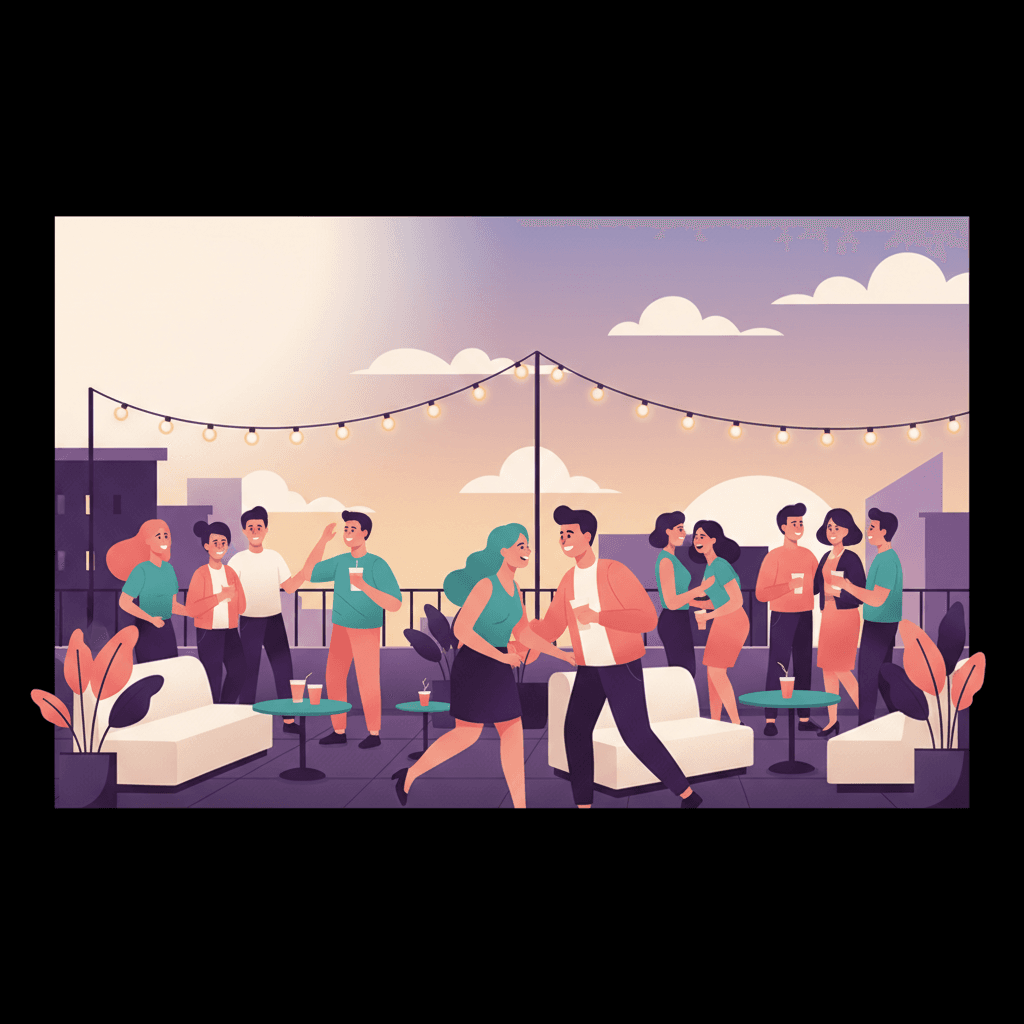
As rooftop bars start filling up again, watch parties get planned, and the energy of a new season shakes people out of their winter hibernation, you have a rare window to meet people the way humans were actually wired to connect—in person, in context, with real social proof. And that window is way more valuable than any algorithm.
The Loneliness Paradox Nobody Talks About
Dating apps promised abundance, and they delivered—just not the kind we wanted. The average active user on major dating apps swipes on hundreds of profiles a month. Match rates, messages sent, conversations started. Yet study after study—and if you've spent any time in spaces where people talk honestly about dating, you've heard this—people report feeling more isolated the longer they stay on apps.
More matches, more loneliness. How does that happen?
Because matching isn't connecting. A match is a mutual swipe. Connection is two people laughing at the same dumb thing that just happened across the bar. Connection is realizing you both hate the same overrated TV show during a watch party argument. Connection is context—and apps strip that away entirely.
When you meet someone through an app, you're deciding whether you like them before you've ever seen how they move through the world. Before you've heard their laugh. Before you've watched them be kind to a stranger or self-deprecating about something embarrassing. You're evaluating a curated dossier and hoping the human matches.
Spoiler: they usually don't match. Not because people are lying (mostly), but because static profiles are a profoundly bad representation of a dynamic, living person.
Why Spring Changes the Equation
There's something real that happens around this time of year. People physically go outside more. Social calendars fill back up. Events that would've felt like too much effort in February suddenly feel completely reasonable—even exciting.
Spring social season isn't just vibe—it's one of the most reliable windows to meet new people organically:
- Rooftop bar openings bring out crowds that are specifically there to be social, not just grab a drink and leave
- March Madness watch parties create instant shared stakes and easy conversation starters (you don't even have to care about basketball)
- Outdoor markets and pop-ups give you somewhere to walk, browse, and bump into people naturally
- Spring mixers and singles events draw people who are specifically ready to put themselves out there after a long winter
- Friend group crossover hangs multiply as the weather improves—your people start doing more with their people
Each of these settings does something an app can't: it gives you a reason to be there and a built-in conversation hook. You're not two strangers evaluating each other in a vacuum. You're two people who both happened to love this band, or root for this team, or come out to this rooftop on the same night.
That shared context isn't a small thing. It's almost everything.
What You Actually Learn About Someone at an Event
Here's a quick test. Think about the last person you matched with on an app. How long did it take you to figure out if you were genuinely compatible?
Now think about the last time you met someone at an event—a party, a mixer, a spontaneous thing that got good. How long did it take?
At events, you get authentic social data in real time:
How they treat people they just met
Are they warm? Awkward in an endearing way? Do they make everyone in the circle feel included, or do they only direct their charm at the person they're interested in? You'll see all of this in the first fifteen minutes.
How they handle social friction
Someone spills a drink. The game takes a dramatic turn. Two strangers start mildly disagreeing about something. How does the person you're watching respond? These moments reveal character in ways no profile question can.
Whether they're actually who they said they were
The profile said "loves to laugh and be spontaneous." Are they laughing? Are they spontaneous? You can answer this in the first hour instead of the third date.
Whether your social energies are compatible
This one is massively underrated. Some people drain you at parties. Some people energize you. You genuinely cannot tell from a photo and three paragraphs—but you can tell within minutes of being in the same room.
The Post-Date Anxiety Trap (and How Events Sidestep It)
One of the most quietly miserable experiences of modern dating is the 24-72 hours after a good date. You had fun. They seemed to have fun. And now you're sitting with your phone wondering if you should text, whether to interpret the silence as disinterest, and low-key catastrophizing about what it all means.
This is a byproduct of meeting strangers with zero shared social context. You have no mutual friends to consult. No upcoming event where you'll naturally cross paths again. No ambient signal that this person is still interested and just hasn't texted yet.
Event-based meeting sidesteps this almost entirely. When you meet someone at a recurring social event, a shared friend group situation, or an organized mixer—there's a natural next chapter built in. Another event. A mutual friend who can casually mention you. A group chat that already exists. The silence isn't silence; it's just the space between two real-world touchpoints.
The stakes of any single interaction are lower when there's a natural ecosystem around it. And lower stakes tend to produce more authentic, less performative behavior from both people.
How to Actually Use Spring Events to Meet Someone
Knowing that events are better for meeting people doesn't help if you're still just showing up, grabbing a drink, and talking to the same three people you came with. Here's how to make spring social season actually work:
Say yes to more things. This sounds obvious, but the math matters. Every event you attend is a chance encounter that could happen. Every event you skip because you're tired is definitely zero chances. Spring energy is real—use it while you have it.
Go to things where you already have a genuine interest. A watch party for a sport you actually follow. A pop-up for a food you actually love. A mixer around a hobby you already have. You'll be more relaxed, more yourself, and your actual personality will show up instead of your first-date performance.
Show up slightly early. This is counterintuitive because showing up early to a party feels uncool. But the first 20 minutes of any event are the highest-density period for meeting new people. Everyone is still moving around, forming new clusters, open to new conversations. Once the groups solidify, breaking in is harder.
Use the environment as a conversation anchor. The game, the food, the band, the weird art installation in the corner—lean into the shared context around you. "What do you think of this place?" is a much stronger opener than anything you'd craft in an app.
Be someone's reason to stay. If a conversation is going well, don't be in a hurry to move on. The best connections form when two people stay in one spot a little longer than they planned because the conversation got too good to leave.
Leverage the second event. This is the killer feature of spring social season. If you meet someone at a rooftop bar opening, there's another rooftop night next weekend. If you connect at a watch party, there are more games. You have a natural, low-pressure reason to invite someone to the next thing—or to run into them there.
A Word on Not Abandoning the Apps Entirely
This isn't an anti-app manifesto. Dating apps remain useful for meeting people outside your existing social orbit, especially if you've moved to a new city or your event calendar is genuinely limited. The problem is treating apps as your primary strategy when they're better suited as a supplementary one.
The research consistently shows that relationships that started in person—through mutual friends, shared activities, or organic encounters—tend to report higher satisfaction and longer duration than those that started with a swipe. That's not a coincidence. It's the compound interest of meeting someone in full context.
Apps are fine for the off-season. But when spring hands you an excuse to be out in the world meeting people like a human animal who was built for exactly this—take it.
What to Look for in Spring Events If You're Single
Not all spring events are created equal for meeting people. Some quick heuristics:
- Structured > unstructured (a mixer with name tags beats a random house party for meeting strangers)
- Recurring > one-off (you want built-in follow-up opportunities)
- Interest-based > purely social (shared passions create better connection than just shared proximity)
- Medium-sized > massive or tiny (50-150 people is the sweet spot—big enough for variety, small enough for actual conversation)
Apps like Hooked are built specifically around this idea—connecting people within the context of real events so that you already know you have something in common before you even start talking. Instead of a blank slate profile, you have a shared RSVP to the same rooftop night. It's a small shift that changes everything about how a conversation begins.
The Bottom Line
Spring is short. The rooftop season, the watch party energy, the first warm weekends when everyone is outside and open—it doesn't last forever. Dating app fatigue, on the other hand, is infinite and renewable.
This year, consider rebalancing. Let the apps be what they are—a tool, not a lifestyle. And let spring social season be what it actually is: one of the best environments humans have invented for meeting other humans in a real, unfiltered, surprisingly joyful way.
Your next meaningful connection is probably not going to be a right swipe. It's probably going to be someone who reaches for the same snack at the watch party and makes a face at the same moment you do.
That's not a romantic fantasy. That's just how people actually work.
Related Articles
How to Meet Someone at a Wedding: A Single's Guide
Wedding season is prime time for singles. Learn how to meet someone at a wedding with practical, no-cringe tips for the cocktail hour, dance floor, and beyond.
Single at a Wedding? How to Actually Meet Someone
Being single at a summer wedding is a hidden dating goldmine. Learn how to meet someone, spark real connection, and turn a wedding moment into something more.
How to Meet Someone at a Wedding When You're Single
Flying solo to a wedding this season? Here's how to enjoy the night, meet people naturally, and maybe leave with more than cake — no awkwardness required.