
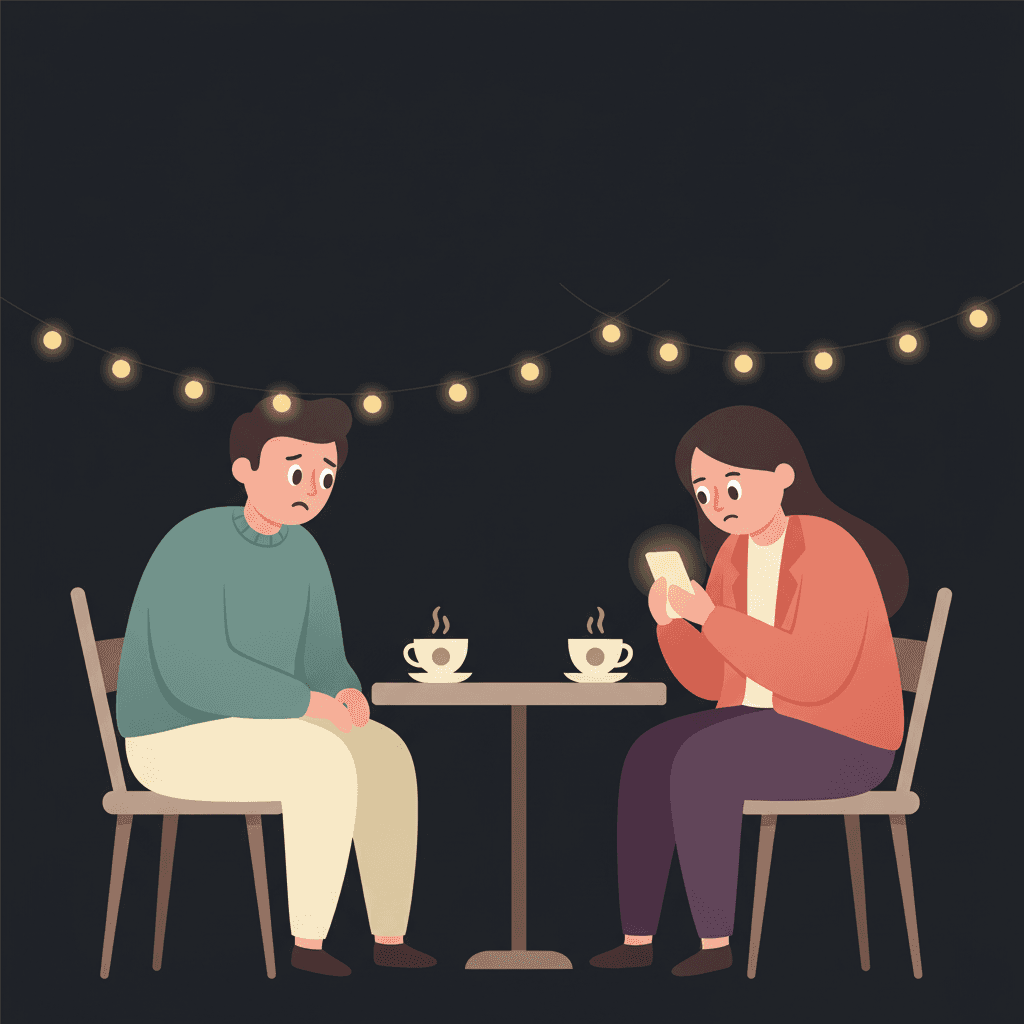
Why First Dates Fail: The Real Reasons Nobody Tells You
Most first dates fail before you even order drinks. Here is the honest breakdown of what is really going wrong — and how to finally change the outcome.
You did everything right. You picked a good spot. You showed up on time. You even had a few conversation topics lined up just in case. And still — somewhere between the second drink and the Uber home — you could feel it: this is not going anywhere.
First dates fail all the time. And the reasons are almost never what people assume.
Most dating advice puts the blame squarely on you: you were too nervous, too eager, too guarded, too something. But the truth is messier and more systemic than that. Modern dating has stacked the deck against first dates in ways that have nothing to do with your personality, your looks, or how funny you are. Understanding what is actually going wrong is the first step toward changing your results.
The Persona Problem: You Are Meeting a Character, Not a Person
Here is the uncomfortable truth about most first dates in the swipe-app era: you are not meeting the person. You are meeting the version of themselves they have spent weeks — sometimes months — carefully constructing.
Dating app profiles are designed for performance. The photos are the best ten shots from hundreds. The prompts are workshopped. The opening line has been reused across dozens of matches. By the time you sit down across from someone, you have already developed feelings (or reservations) about a fictional character.
Real people are messier. They have weird laughs and strong opinions about things you have never thought about. They get nervous and over-explain or go too quiet. None of that shows up in a curated profile — and none of it is a dealbreaker unless the gap between the profile and reality is too large to bridge in ninety minutes over cocktails.
This mismatch is one of the most underrated reasons first dates go sideways. You are not incompatible. You are just both playing catch-up with reality.
What this looks like in practice
You matched because she looked adventurous and spontaneous. But in person, she is more cautious and measured. Not a bad person — just not who you thought you were meeting. The dissonance creates friction before either of you has said anything worth remembering.
The fix: Go in with curiosity, not confirmation bias. Your goal is not to verify whether the profile is accurate. It is to meet a real person for the first time.
The Pressure Cooker Setting
Think about the format we have collectively agreed is normal for a first date: two strangers, sitting face-to-face, in a quiet bar or restaurant, with the explicit shared understanding that they are evaluating each other as romantic partners.
That is an objectively strange and high-pressure situation.
Research on social interaction consistently shows that people are more relaxed, more themselves, and more likable when they are doing something rather than just talking about themselves. Side-by-side activity reduces self-consciousness. Shared experience creates natural conversation. The environment does half the emotional work.
The traditional first date format does the opposite. It isolates two people in a pressure cooker and asks them to perform likability on demand.
No wonder so many first dates feel like job interviews.
The conversation spiral
Without a shared context or activity, most first date conversations follow the same script: where are you from, what do you do, how long have you been on the app, any siblings. It is not that these questions are wrong — they are just thin. They gather data without building connection.
Connection comes from sharing reactions to things, not exchanging resumes. It comes from laughing at the same moment, getting unexpectedly passionate about the same topic, or discovering a surprising common reference. Those moments happen when something external triggers them — a band you both recognize, a bizarre thing that just happened in the room, a question that catches you both off guard.
Ghosting Has Broken the Feedback Loop
Here is a dynamic nobody wants to talk about but everyone has experienced: the date that seemed fine — maybe even good — followed by complete silence.
No explanation. No closure. Just a vanishing act.
Ghosting has become so normalized in modern dating that most people have simply accepted it as the cost of entry. But its impact on first dates is more corrosive than it looks. When you know that any date could end in unexplained silence, you start hedging. You hold back a little. You do not fully invest because you have been burned before.
The result is that both people are showing up to first dates with their guard partially up — not because they are unfriendly, but because experience has taught them not to be too present too soon.
This is a rational defense mechanism and it completely kills authentic connection.
The arithmetic is brutal: two people who are both 70% present, both slightly guarded, both waiting to see if the other person disappears — that is a first date where neither person actually shows up. And then both people go home thinking the other one was not interested.
Lifestyle Mismatch You Could Have Caught Earlier
Some first dates fail not because of chemistry or nerves but because of fundamental incompatibility that had nothing to do with attraction.
You like going out three nights a week. They prefer quiet weekends at home. You want kids eventually. They are certain they do not. You are looking for something serious. They are freshly out of a relationship and very much not.
These are not things that come up easily in messaging. They can be awkward to raise before a first date without seeming like you are interviewing someone for a life partnership over text. So people meet anyway — and then figure it out in person, usually in the last fifteen minutes when the date is winding down and it is too late to matter.
This is a failure of the funnel, not a failure of chemistry. The format does not surface the things that matter until after you have already invested an evening.
The Recency Bias Trap
You had a bad date three weeks ago. The person was rude to the server, talked about their ex too much, and checked their phone twice. Fine — that is data.
But that data is not about the person sitting across from you tonight. It is about the person from three weeks ago. The problem is that your nervous system does not always make that distinction cleanly. You are slightly more guarded. Slightly quicker to find red flags. Slightly less generous with ambiguous moments.
Recency bias is invisible but powerful. A string of disappointing dates makes it harder to show up openly to the next one — which makes disappointing dates more likely, which makes it harder to show up openly — and so on.
Breaking this loop requires actively resetting your expectations, not just intellectually but emotionally. One concrete way to do that: change the format. Do something different. Meet somewhere new. The physical context shapes your internal state more than you might think.
What Actually Works: First Date Formats That Reduce Friction
If the traditional drinks-at-a-bar setup is the problem, what is the alternative?
Shared activity with built-in conversation. Think trivia night, a live music set, an outdoor market, a gallery opening, a cooking class. These settings give you something to react to together. The activity does not need to be elaborate — it just needs to be something beyond face-to-face interrogation.
Lower-investment formats for earlier in the funnel. Coffee before dinner. A short walk before committing to two hours at a restaurant. This reduces the sunk-cost pressure on both sides and makes it easier to relax.
Meeting in a context where you already have something in common. This is underrated. If you already know you both love jazz, meeting at a jazz venue removes one layer of uncertainty. The shared reference is already established. You are not starting from zero.
Apps like Hooked are built around this exact insight — connecting people through shared events, so you already have context about each other before the awkward "so what do you do" phase. When you have both attended the same rooftop mixer or live show, the first conversation has a foundation. That foundation changes everything.
The Authenticity Gap
One of the most consistent patterns in first dates that go nowhere: both people are performing a slightly polished version of themselves and neither one is quite real.
This is not a character flaw — it is a very human response to evaluation. When you feel like you are being assessed, you naturally present your best self. The problem is that "best self" often means "least controversial self," which means the most interesting parts of you stay hidden.
The dates that turn into something are almost always the ones where someone slips — where something real and unfiltered comes out. A strong opinion. An embarrassing story. A genuine laugh at something stupid. These moments of authenticity are magnetic precisely because they are rare.
The counterintuitive advice: be a little less impressive. Share the story that does not make you look great. Disagree with something. Let yourself be weird. The version of you that is trying to seem impressive is less interesting than the version that is just honest.
How to Recalibrate Your First Date Strategy
A few concrete resets worth trying:
- Change the venue format. Get off the barstool. Do something that gives you side-by-side experience rather than face-to-face evaluation.
- Go in without a verdict deadline. Give yourself permission to not know how you feel yet. Chemistry is not always immediate — and the pressure to know by dessert is artificial.
- Ask one question that is not on the standard script. "What is something you changed your mind about recently?" gets a more interesting conversation than "what do you do for fun?"
- Meet people in shared contexts when you can. Events, venues, activities — shared experience before a first date changes the dynamic entirely.
- Let the recency bias land somewhere else. A bad run of dates is information about the format, not about your worth as a person or your long-term odds.
The Bigger Picture
Most first dates fail not because of lack of attraction or bad luck but because the entire structure of modern first dates works against connection. The format is high-pressure. The context is artificial. The information asymmetry is enormous. And both people are often carrying invisible baggage from previous experiences.
Understanding this does not guarantee better dates immediately. But it does mean you can stop taking bad dates as personal evidence that something is wrong with you — and start making smarter choices about how, where, and with whom you show up.
The date format is not fixed. Change the format, and you change your odds.
Hooked is a free app that matches you with people at real events — because the best first impressions happen when you already have something in common. Learn more.
Related Articles
How to Meet Someone at a Wedding: A Single's Guide
Wedding season is prime time for singles. Learn how to meet someone at a wedding with practical, no-cringe tips for the cocktail hour, dance floor, and beyond.
Single at a Wedding? How to Actually Meet Someone
Being single at a summer wedding is a hidden dating goldmine. Learn how to meet someone, spark real connection, and turn a wedding moment into something more.
How to Meet Someone at a Wedding When You're Single
Flying solo to a wedding this season? Here's how to enjoy the night, meet people naturally, and maybe leave with more than cake — no awkwardness required.