
Tired of Dating Apps? Why Meeting People at Events Actually Works
Swipe fatigue is real. Discover why meeting people at real events creates stronger connections than apps — and how to make spring social season work for you.
Meeting someone new used to feel exciting. Now, for a lot of us, opening a dating app feels more like another chore — swipe, match, ghost, repeat. If you've felt this way, you're not imagining it. Dating app fatigue is one of the defining emotional experiences of the mid-2020s, and it's driving more people to ask a simple but powerful question: what if the answer isn't a better app — but a better environment?
Event-based dating isn't a new idea, but it's having a serious moment. And if you're someone who's spent months trying to make swipe-based apps work, spring is the perfect time to try something that actually feels good again.
Why Dating Apps Leave You Exhausted
It starts innocently enough. You download an app, set up a profile, and start swiping. You get a few matches. Some conversations go nowhere. Others feel promising but fizzle before a first date. You go on a date that wasn't quite what the profile suggested. You try again.
After a while, the loop itself becomes the problem. Dating app usage is psychologically demanding in ways we don't always consciously register:
- Infinite choice paradox: With thousands of potential matches, the brain can't commit. Research on decision fatigue shows that more options often lead to less satisfaction with any single choice — not more.
- Gamification without payoff: Swipe mechanics are designed to keep you engaging, not to help you find a partner. The variable reward loop (swipe, match, swipe, no match) is closer to a slot machine than a matchmaking service.
- Ghosting as the norm: When rejection costs nothing and there's always another option queued up, follow-through becomes optional. Users have increasingly accepted ghosting as just... how it works.
- Profile optimization anxiety: Your entire personality has to fit into six photos and three prompts. You optimize for likes, not for genuine connection. The person you're presenting online may be a performance, not you.
The result? A generation of people who are simultaneously more connected and more lonely than any that came before. Not because dating is hard, but because the medium actively works against real connection.
What Changes When You Meet at an Event
Events flip almost every one of these dynamics. Here's why they work:
You Already Have Something in Common
The most underrated advantage of meeting someone at an event is the shared context. You didn't swipe into each other's lives from opposite ends of the internet — you're both at the same rooftop bar, the same trivia night, the same spring mixer. That's not nothing. It's actually a lot.
Shared experience is one of the most reliable foundations for early-stage connection. Social psychologists call it the proximity-similarity effect: we're more likely to connect with people who share our environment and, by extension, our tastes and social patterns. If you're both at a jazz brunch on a Sunday in April, you already know something real about each other.
The Pressure Comes Off
One of the strangest things about dating apps is how much explicit romantic intent is baked into every interaction. You're both there for the purpose of meeting a romantic partner. That pressure — the meta-awareness of "this is a date" — can make even good conversations feel stiff.
Events give you cover. You can talk to someone because the conversation is interesting, not because you're "supposed to." If there's chemistry, you can pursue it. If not, there's no awkward exit — you just turn toward the next conversation. The stakes feel lower even when the outcomes are just as meaningful.
Non-Verbal Cues Are Back in the Picture
Dating app profiles are static. The way someone carries themselves, how they laugh, their energy in a room — none of that translates to a photo grid. But in person? You pick up on all of it instantly.
Research on communication consistently shows that a substantial portion of interpersonal attraction is conveyed through non-verbal channels: eye contact, posture, vocal tone, physical presence. When you meet someone at an event, your brain is processing all of these signals simultaneously. You get a much richer, faster read on compatibility than any algorithm can provide.
There's a Natural Conversation Starter
The eternal pain of app-based dating is the opening message. What do you say? Reference the photo? Drop a pun? It's awkward because the context is artificial.
At an event, the event itself is the icebreaker. "Have you been to one of these before?" "What do you think of the DJ?" "That trivia answer was robbed." You're not manufacturing a conversation — you're stepping into one that's already happening.
How to Actually Meet People at Events (Not Just Attend)
Showing up is the first step. But there's an art to making the most of a social event if you're genuinely trying to meet new people:
1. Arrive early, not late
This sounds counterintuitive. We're conditioned to believe showing up fashionably late is cooler. But early in an event, groups are smaller and more fluid. It's far easier to start a conversation with one or two people than to break into an established circle.
2. Position yourself in high-traffic zones
The bar. Near the food. By the entrance. These are natural gathering spots where conversation starts organically. Standing in a comfortable corner limits your exposure — and your options.
3. Use the event as your subject
Ask people what brought them here, what they think of the venue, whether they've tried the cocktails. You're not opening with a personal question — you're inviting them to share an opinion, which is a much more natural social entry point.
4. Look up and put your phone down
If you're scrolling, you're invisible. If you're present and making eye contact, you're approachable. This is the single biggest behavioral shift most people can make at any social event.
5. Go with a friend, but split up
Having a wingman or wingwoman is great. Spending the whole night talking only to them is not. Agree before you arrive to circulate independently and check in every 20 minutes or so. You'll cover more ground and have better conversations.
6. Follow up within 24 hours
If you connect with someone and exchange contact info, message them while the memory is fresh. Reference something specific from your conversation — it signals you were genuinely paying attention, which is rare and memorable.
Why Spring Is the Perfect Time to Make This Change
There's something about spring that makes social energy genuinely spike. Outdoor events come back. Patios reopen. People emerge from winter and actively want to be out in the world again.
This spring is shaping up to be a particularly rich social season:
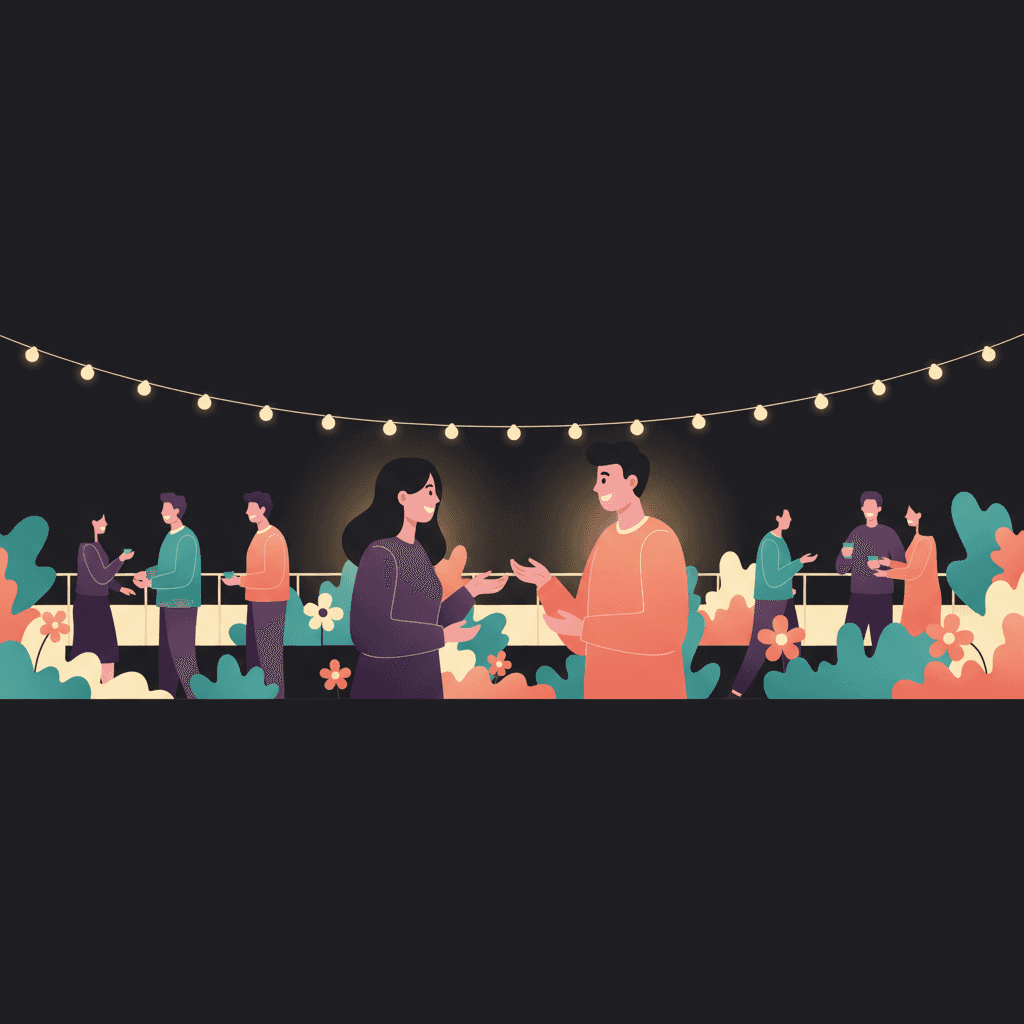
- Rooftop and terrace events are returning across most cities, turning bars and venues into outdoor gathering spaces that feel instantly more alive
- Festival season is kicking off — from Coachella and its satellite events to local music festivals and food fairs, the next few months are dense with shared experiences
- Spring sports culture creates low-pressure communal settings — March Madness watch parties, opening day games, outdoor sports events — where conversation flows easily
- Singles mixers and social clubs tend to run their highest-attendance events in spring and fall, when people are actively refreshing their social lives
If you've been meaning to get out more, this is your window. The calendar is full, the weather is cooperating, and the cultural mood is genuinely social.
Making Technology Work For You
None of this means technology has no role in how you meet people. The key is using it in service of real-world connection rather than as a substitute for it.
Apps like Hooked are built specifically around this idea — you join an event, discover who else is attending, and start connecting with people before you're even in the room. The event is the context; the app just helps you navigate it. It's a fundamentally different model from swiping through a grid of strangers, and the conversations that come out of it tend to feel different, too.
The goal isn't to eliminate technology from your dating life. It's to use it as a bridge to real-world interaction rather than a replacement for it.
The Mindset Shift That Makes Everything Easier
The deepest change isn't tactical — it's about reframing what you're trying to accomplish. Dating app culture tells you that every interaction should be optimized toward a specific romantic outcome. That framing is exhausting, and it makes every conversation feel like an audition.
Event-based socializing lets you show up with a simpler goal: have interesting conversations with people you wouldn't otherwise meet. Some of those people will become friends. Some might become something more. Most will just be good conversations — and that's fine. That's what a social life looks like.
When you stop treating every interaction as a high-stakes romantic evaluation, you become more relaxed, more interesting to talk to, and paradoxically, more attractive. People can tell when someone is present versus when they're performing.
A Simple Framework to Get Started This Season
If you've been relying exclusively on apps and want to build more of a real-world social life, here's a practical starting point:
- Identify two or three types of events you'd genuinely enjoy — not just as dating opportunities, but as experiences. Art shows, trivia nights, cooking classes, rooftop bars, concerts. Start with what you actually like.
- Commit to one event per week for the next month. It doesn't have to be a production — even a regular Thursday pub quiz counts.
- Set one conversation as your goal per event. Not a match, not a date — just one real conversation worth having. That's the baseline you're building.
- Expand your radius gradually. Once weekly events feel comfortable, try a larger mixer or festival. Social confidence compounds with practice.
Dating app fatigue isn't a personal failure — it's a rational response to a medium that was never quite built for the job it was sold as doing. The good news is that the alternative has always been there, waiting. It's called going out and being human with other humans.
This spring, try that instead.
Related Articles
How to Meet Someone at a Wedding: A Single's Guide
Wedding season is prime time for singles. Learn how to meet someone at a wedding with practical, no-cringe tips for the cocktail hour, dance floor, and beyond.
Single at a Wedding? How to Actually Meet Someone
Being single at a summer wedding is a hidden dating goldmine. Learn how to meet someone, spark real connection, and turn a wedding moment into something more.
How to Meet Someone at a Wedding When You're Single
Flying solo to a wedding this season? Here's how to enjoy the night, meet people naturally, and maybe leave with more than cake — no awkwardness required.