
Swipe Fatigue Is Real: Why Events Beat Apps This Spring
Tired of swiping with nothing to show for it? Discover why real-world events create stronger connections and how to make the most of spring dating season.
Dating apps promised us love at our fingertips. Millions of us downloaded them, crafted our bios, uploaded our best photos, and started swiping. And yet -- here we are, more connected than ever on paper, but somehow lonelier in practice. If you've ever closed an app mid-scroll and felt a hollow kind of exhaustion you couldn't quite name, you've felt swipe fatigue. And you're not alone.
Spring is here, the patios are open, the rooftops are calling, and there's a quiet cultural shift happening: people are putting down their phones and showing up in person. This piece is about why that shift matters, what it means for your dating life, and how to actually meet someone worth meeting this season.
What Swipe Fatigue Actually Is (and Why It's Getting Worse)
Swipe fatigue isn't just being tired of bad dates. It's a specific kind of emotional burnout that comes from sustained, low-reward effort. You swipe, you match, you trade a few messages, and then... nothing. Or you go on the date, and it's fine, perfectly fine, but there's no spark, no aliveness -- just two people performing a version of themselves for a stranger.
Research on decision fatigue tells us that the more choices we evaluate, the worse our judgment becomes. Dating apps are essentially a machine designed to maximize the number of choices you evaluate without helping you make a better one. You're not choosing a partner -- you're curating a queue.
The result is a paradox: more options, less satisfaction. More matches, less meaning. And the human brain, built for genuine social connection over thousands of years, starts to register this mismatch as a low-grade kind of loneliness -- even when the notifications keep coming.
The Touch Starvation Problem Apps Can't Solve
There's something apps fundamentally can't give you: presence. The warmth of being in the same room as someone. The way a laugh lands differently when you're next to the person laughing. Eye contact that isn't mediated by a screen.
Touch starvation and social isolation have been quietly rising for years. We have more communication tools than any generation in history -- and yet, for many people, the feeling of genuine human connection has become harder to access, not easier. Swiping in bed at midnight isn't a solution to this. In many ways, it's a substitute that makes the original hunger worse.
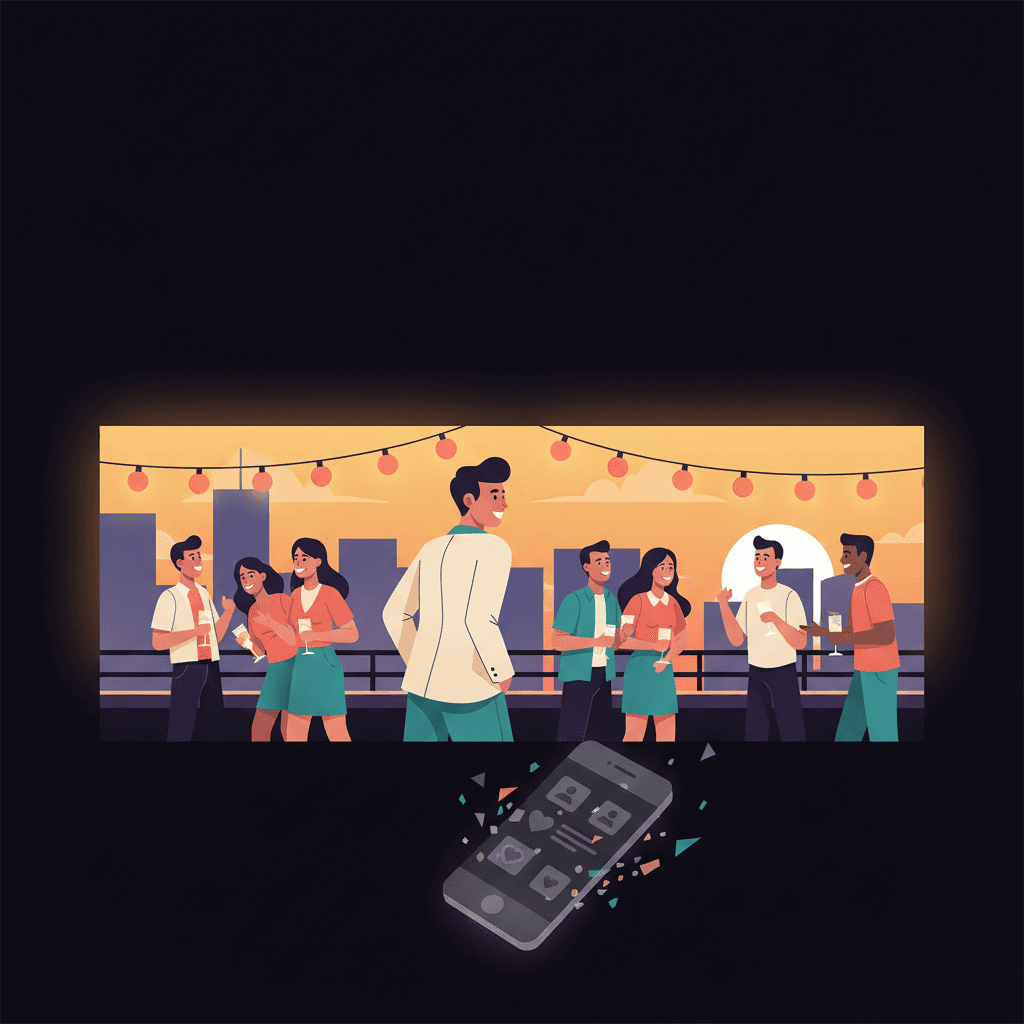
Real-world events -- a rooftop mixer, a speed dating night, a live music venue, a spring pop-up market -- give you the thing apps can't: actual humans, in actual space, reacting to you in real time. Your humor lands. Your presence is felt. Chemistry has a chance to exist before anyone has to type a clever opener.
Why Spring Is Legitimately the Best Time to Meet Someone
Seasonal effects on mood and social behavior are well-documented. Longer days, warmer temperatures, and more outdoor activity genuinely shift people's energy. Spring is when social seasons restart -- venues reopen their patios, event calendars fill up, and people who spent winter hibernating feel a pull toward going out and doing things.
This creates a specific kind of social energy that's genuinely hard to manufacture in other seasons. People are more open, more present, more willing to talk to a stranger. The stakes feel lower at a rooftop bar with string lights and a spring breeze than they do on a Tuesday in February.
There's also a psychology here: events in spring tend to attract people who are choosing to be there. Someone who RSVP'd to a singles mixer or a themed social night has self-selected for openness and intention. That's a fundamentally different starting point than someone who swiped right at 11pm because they were bored.
The Spring Social Calendar Worth Knowing About
Here's what the spring event landscape looks like, and how to use it:
- Rooftop bars and patio openings: Low pressure, high energy. Great for bumping into people organically without the explicit "this is a singles event" pressure.
- Live music venues: Shared experience creates instant common ground. You don't need a conversation opener when you're both watching the same set.
- Themed singles mixers: Yes, they can feel awkward for exactly five minutes. Then they don't. The explicitness of everyone being there to meet people actually removes a lot of the social ambiguity.
- March Madness watch parties: Sports context is a social lubricant. There's always something to react to, something to debate, something to bond over.
- Spring markets and food festivals: Lower stakes than a night out. Longer natural dwell time. More excuses to keep talking.
The Hidden Advantage of Meeting at an Event
When you meet someone at an event, you immediately have something in common: you were both there. You made the same choice. That's a tiny signal, but it's a real one. It tells you something about shared taste, lifestyle, and willingness to show up.
Compare that to a dating app match, where the only thing you know for certain is that you both swiped right on a curated photo. One of these gives you shared context. The other gives you a JPEG.
The first conversation at an event is also structurally different. You're not performing for a screen -- you're actually responding to a person. Their energy, their humor, their nervousness or ease. You're reading a hundred micro-signals at once, the way human beings are biologically wired to. Chemistry assessment, which takes weeks of texting to approximate online, happens in minutes in person.
This is why people who meet at events report higher rates of actually going on a second date. The bar isn't just "does the text version of this person seem interesting" -- it's "did I actually want to keep talking to them when I was standing next to them?" That's a much better filter.
How to Show Up Authentically (Not Just Physically)
Going to an event isn't a magic trick. You can walk into a room full of interesting people and still leave without a single meaningful exchange, because showing up physically is just the beginning.
Here's what actually works:
Give yourself a brief warmup. The first ten minutes of any social event feel awkward for almost everyone. Don't bail before you've actually settled in. Give it time to feel natural.
Have one genuine interest question ready. Not "what do you do?" -- something more alive. "What made you come to this tonight?" or "Have you been to this venue before?" Simple, but it opens a conversation instead of triggering a rehearsed bio recitation.
Let silences breathe. The urge to fill every silence with nervous chatter is real, but conversational pauses aren't failures. Comfortable silence is actually a good sign.
Be honest about first-date energy. You don't have to pretend you're not there to meet people. Everyone knows why they're at a singles event. A little self-aware humor about that is far more charming than performing nonchalance.
Don't spend the night on your phone. This seems obvious. It isn't, apparently. Glancing at your dating app while you're at a literal event to meet people is its own kind of irony -- and a missed opportunity.
The Three Questions to Ask Before You Leave
If you've had a conversation that went well -- or even just okay -- use these three questions to filter faster:
-
"Are you based around here?" Logistics matter. Chemistry is great; chemistry with someone who lives two hours away requires more intentional management.
-
"What do you usually get up to on weekends?" This tells you so much more than a job title. It's a values question in disguise.
-
"Would you want to grab coffee sometime?" Direct, low-stakes, clear. Not a marriage proposal. If they're interested, they'll say yes. If they're not, you've both saved a week of awkward texting.
When Apps Have a Role (and When They Don't)
This isn't an anti-app manifesto. Apps have their place -- they extend your reach, they're useful for moving slowly, and they're the right tool for plenty of situations. But they work best as a supplement to a social life, not a replacement for one.
The problem isn't the apps themselves. It's the expectation that passive digital engagement can substitute for active, embodied social experience. It can't. Not really. Not in the ways that matter.
The people who seem to have the best luck in modern dating -- the ones who actually end up in relationships rather than in endless situationships -- tend to share a common trait: they go places. They join things. They say yes to events they're slightly unsure about. They make themselves findable in the real world, not just on a profile.
Apps like Hooked are built around this exact insight -- that the best context for meeting someone is the event you're both already at. Match before you meet, or discover each other in real time. Either way, there's a shared experience that makes everything that follows more real.
Making This Spring Count
Spring social season is short. The energy that makes it good -- the openness, the outdoor settings, the warm evenings that encourage people to linger -- peaks and then fades back into the routine of summer schedules and August heat.
If you've been waiting for a reason to put down the app and go somewhere, this is it. Not because swiping is bad, but because you already know what swiping feels like. You know the highs (exciting match) and the lows (ghosted again). The loop is familiar. Events offer something different: real people, real context, real chemistry.
Go to the rooftop opener. Say yes to the mixer your friend mentioned. Show up to the watch party. Talk to the person standing next to you at the spring market.
You already know how to scroll. You might be surprised how much you already know how to connect -- if you give yourself the chance.
Related Articles
How to Meet Someone at a Wedding: A Single's Guide
Wedding season is prime time for singles. Learn how to meet someone at a wedding with practical, no-cringe tips for the cocktail hour, dance floor, and beyond.
Single at a Wedding? How to Actually Meet Someone
Being single at a summer wedding is a hidden dating goldmine. Learn how to meet someone, spark real connection, and turn a wedding moment into something more.
How to Meet Someone at a Wedding When You're Single
Flying solo to a wedding this season? Here's how to enjoy the night, meet people naturally, and maybe leave with more than cake — no awkwardness required.