
How to Meet People at Spring Events When You Go Solo
Attending a spring event alone? Here is how to walk in confident, spark real conversations, and leave with connections that actually matter.
Going to a spring event solo is one of the most underrated moves in modern dating. No wingman to bail early, no couple friends who drift off together — just you, the venue, and a room full of people who showed up for exactly the same reason: to be somewhere worth being.
But walking in alone can feel exposing, even for the most socially confident people. That knot in your stomach when you do not immediately see a familiar face? Completely normal. The difference between people who leave spring events with new connections and those who just leave comes down to a few small but high-leverage choices.
Here is how to do it right.
Why Going Solo to Spring Events Actually Works in Your Favor
Before the tactical stuff, let us reframe the situation entirely.
When you attend an event with a group, you are already socially satisfied. Your social needs are met by the people you came with. You orbit each other, laugh at your own inside jokes, and leave having had a great time — with no new people in your phone.
Going solo removes that safety net. And that is exactly the point.
You become approachable. Groups have invisible force fields. A solo person standing near the bar? Open invitation. People can walk up without feeling like they are interrupting something.
You are forced to be present. You cannot hide in group dynamics. Every lull, every awkward pause — you sit in it and come out the other side. This builds genuine social muscle that swiping on apps never will.
You move on your terms. See someone interesting across the room? You can go talk to them immediately. No need to consult the group chat, wait for a friend who is "almost ready," or lose the moment entirely.
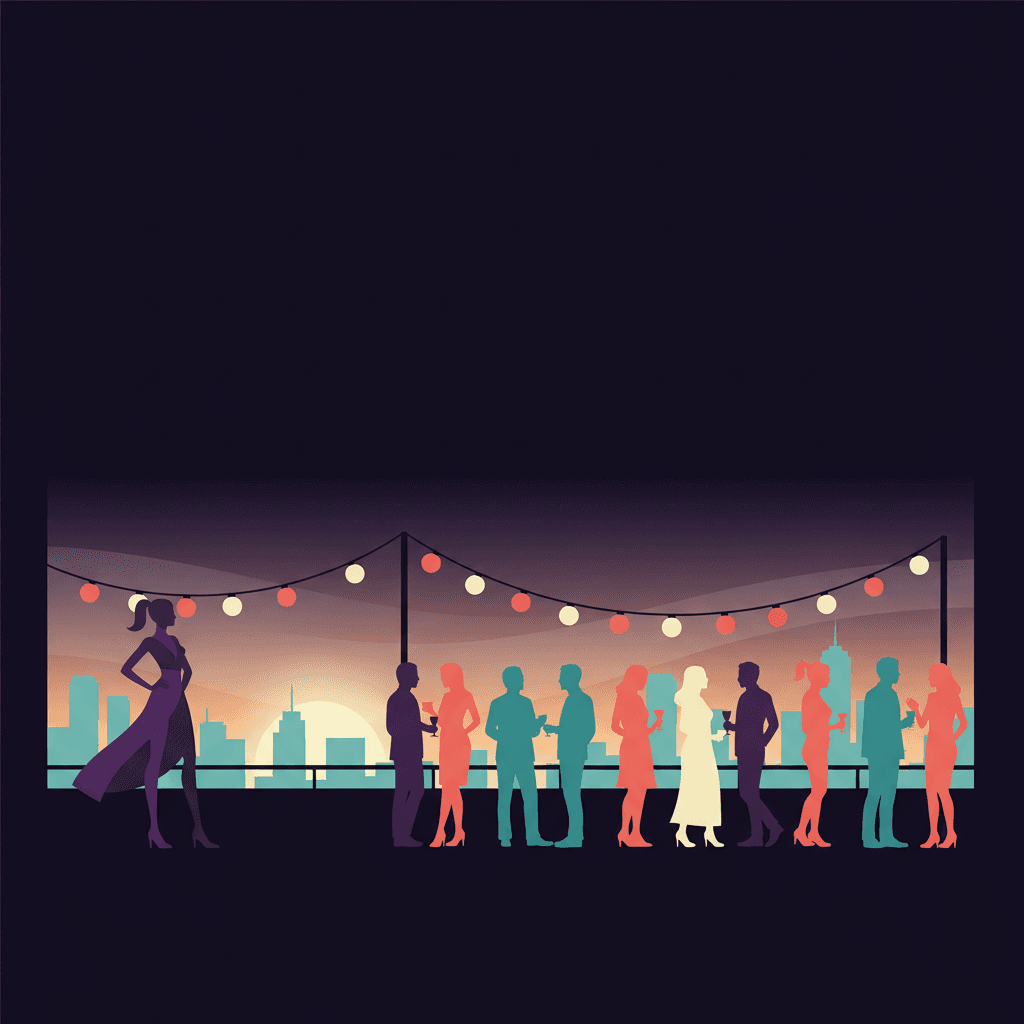
Spring events — rooftop parties, outdoor music nights, patio bar crawls, Coachella satellite events, festival warmup nights — are uniquely suited to solo attendance because they are built around shared experience. The event itself is the ice breaker. You are not trying to conjure chemistry from nothing; you are reacting to something that is already happening around you.
Before You Go: The Pre-Event Mindset Reset
The most impactful thing you can do happens before you walk through the door.
Set One Concrete Intention
Not "meet someone special" — that is too high-stakes and too vague. Instead, try: "I am going to have one real conversation tonight." Not a surface-level chat about the weather or the DJ. A real one. Ask one genuine question. Find out one thing about someone that surprises you.
One real conversation. That is it. This removes the pressure of a great outcome while keeping you in an active, curious mode rather than a passive, waiting mode.
Dress for Confidence, Not Performance
There is a difference between dressing to impress and dressing to feel like yourself. The latter is what matters at live events. You will be moving around, possibly dancing, definitely standing for long stretches. Wear something that makes you feel sharp but does not require maintenance — adjusting, checking, worrying.
Confidence is a physical state before it is a mental one. If you feel good in what you are wearing, your posture opens, your eye contact holds, and strangers read that signal immediately.
Arrive on the Earlier Side
This runs counter to what most people do — show up late, seems cooler. But early arrivals get to watch the room fill, which is a massive psychological advantage. You will see who else comes in solo, identify the people who seem most open and energetic, and find your comfortable spots in the venue before it is crowded.
You are not showing up early because you are eager. You are showing up early because you are strategic.
At the Event: How to Actually Start Conversations
Here is where most advice gets unhelpfully generic. "Just be yourself!" Thanks, very helpful.
Use the Event as the Hook
This is the most natural opener that nobody uses enough. You are surrounded by shared stimulus — the music, the venue design, the crowd energy, whatever is happening on stage. Comment on it. Not as small talk, but as genuine observation.
"This lineup is unreal for a Thursday night." "I did not expect this view from up here." "Have you been to any of their other shows?"
These are not lines. They are real reactions to a real environment. The difference between a forced opener and a natural one is usually just whether it is rooted in something actually happening.
Read the Cluster Signals
Not every group is approachable. Look for:
- Open body language: People with their shoulders turned outward, facing the room rather than inward toward each other
- Lulls in conversation: A brief pause in a small group is an invitation, not an intrusion
- Eye contact from the group: If someone in a cluster makes sustained eye contact with you across a room, they are sending a signal
Avoid tight circles, couples leaning into each other, and anyone who seems intensely mid-conversation. Respect social context.
The Two-Question Rule
When you start a conversation, ask one question. Get the answer. Then ask one follow-up based on what they just said — not a prepared question, but a natural one pulled from their response. This alone puts you in the top 5% of conversationalists at any event.
Most people listen to respond. You are listening to understand, and people feel that distinction immediately.
"Oh, you moved here six months ago — what made you pick this city?"
That follow-up is worth more than any witty opener.
Allow Exits Gracefully
One of the social anxieties around solo events is the fear of being trapped in a bad conversation with no escape. So let us kill that fear now.
Any conversation can end cleanly and warmly: "I am going to grab another drink, but it was great meeting you." Full stop. No one is trapped. No one is rude. You are not being evaluated on whether you stayed in one cluster all night.
This knowledge frees you up to be more present in each conversation because you know you can move on whenever it is naturally time.
Reading Green Flags vs. Red Flags in Real-Time
One underrated benefit of meeting people at events versus apps: you get to see how someone actually behaves in a social setting, not just how they present themselves in a curated profile.
Pay attention to:
Green flags in person:
- They ask you questions back, not just answering and letting silence fall
- They make genuine eye contact, not performative eye contact
- They are warm to other people around them — servers, friends who approach, strangers nearby
- They laugh without checking to see if you are laughing too
Red flags in person:
- They constantly scan the room while you are talking in a dismissive, distracted way
- They speak about their own stories exclusively without any curiosity about yours
- They are visibly rude or dismissive to service staff
- They are not where they claim to be, physically present but mentally elsewhere
These observations are worth far more than any dating app bio because behavior in a social context is genuinely hard to fake.
After the Event: The Follow-Up That Most People Skip
Meeting someone is step one. Every connection you make at a spring event lives or dies on what happens next.
Get Contact Info in the Moment — Not at the End of the Night
"We should hang out sometime" at the end of a conversation is weak. "What is your Instagram?" or "Can I grab your number?" in the middle of a great conversation — while the energy is live — is strong. You are not asking because the night is over and you feel obligated. You are asking because the conversation made you want to keep it going.
Follow Up the Same Night or the Next Day
Not a week later. A brief message the night of or the morning after — referencing something specific from your conversation — is the difference between someone who becomes a real connection and someone who becomes a vague memory.
"Had a great time talking about [specific thing]. We should actually do [specific plan]."
The specificity is what makes it real. Anyone can send "Hey, nice to meet you!" The people worth knowing send something that proves they were actually listening.
The Longer Game
Not every great event conversation turns into a date. Some turn into friendships. Some turn into professional connections. Some plant seeds that become something six months later.
Treat the people you meet at events like you would any valuable relationship — with patience and genuine interest in who they are, not just what role you want them to play in your life.
Why Event-Based Socializing Is Having a Moment
There is a reason spring social season feels different from the swipe-and-chat routine that dominates most of the dating calendar. Events give you something apps cannot manufacture: shared context.
When you meet someone at a rooftop bar during a golden hour set, you have a story. A real one. "Where did you meet?" "At this incredible outdoor show in April." That story has texture because it is built on something real you both experienced.
Apps create matches. Events create memories. The former can lead to the latter, but it is a longer, more effortful path.
Platforms like Hooked are built around this exact insight — letting you discover and connect with other attendees before you even walk in the door. The intent is already baked in. You are not guessing whether someone is there to meet people; that is the whole point of the event.
But even without any app at all, showing up solo to the right spring events is one of the highest-leverage social moves you can make this season. The energy is right. The weather is cooperating. Rooftop season is open. All you have to do is walk in the door.
The Short Version
Going to spring events solo and actually meeting people comes down to a handful of things:
- Arrive with one concrete intention — one real conversation is enough
- Use the event as your opener — it is already there and it is real
- Read the room for open clusters and approachable body language
- Ask follow-up questions based on what people actually say
- Get contact info mid-conversation, not as a goodbye
- Follow up fast and specifically, referencing something that proves you were listening
Spring is the easiest time of year to pull this off. The events are better. The crowds are more open. And everyone, in some small way, is hoping to meet someone worth knowing.
You do not need a wingman. You just need to show up.
Related Articles
How to Meet Someone at a Wedding: A Single's Guide
Wedding season is prime time for singles. Learn how to meet someone at a wedding with practical, no-cringe tips for the cocktail hour, dance floor, and beyond.
Single at a Wedding? How to Actually Meet Someone
Being single at a summer wedding is a hidden dating goldmine. Learn how to meet someone, spark real connection, and turn a wedding moment into something more.
How to Meet Someone at a Wedding When You're Single
Flying solo to a wedding this season? Here's how to enjoy the night, meet people naturally, and maybe leave with more than cake — no awkwardness required.